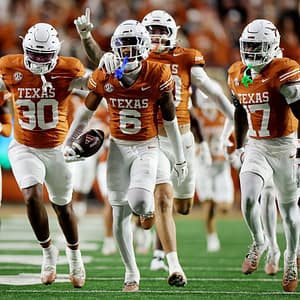
Every football expert agrees: games are won in the trenches. For the Longhorns, this has become a challenge. Last season, they were a finalist for the Joe Moore Award, football’s top honor for teamwork.
Coach Kyle Flood is on a quest for consistency. He believes that continuity leads to consistency. But in today’s fast-paced game, finding this is like trying to herd cats on roller skates.
Important players are leaving. Connor Stroh and D.J. Campbell are gone. Trevor Goosby is thinking about the NFL Draft. The team’s late-season lineup is fading fast.
So, what’s the next move? The transfer portal is tempting. But Flood knows it’s not a lasting solution. The dream is to build through high school recruits. The reality is constantly starting over.
The 2026 challenge is more than just keeping players. It’s about strategically replacing talent before SEC defensive linemen arrive. This is the first, and most crucial, step.
Run-blocking performance
The story of Texas’s 2025 ground game is more like a warning than a playbook. They average just 129.7 rushing yards per game. This is far below average and shows a big problem for a team known for its strength.
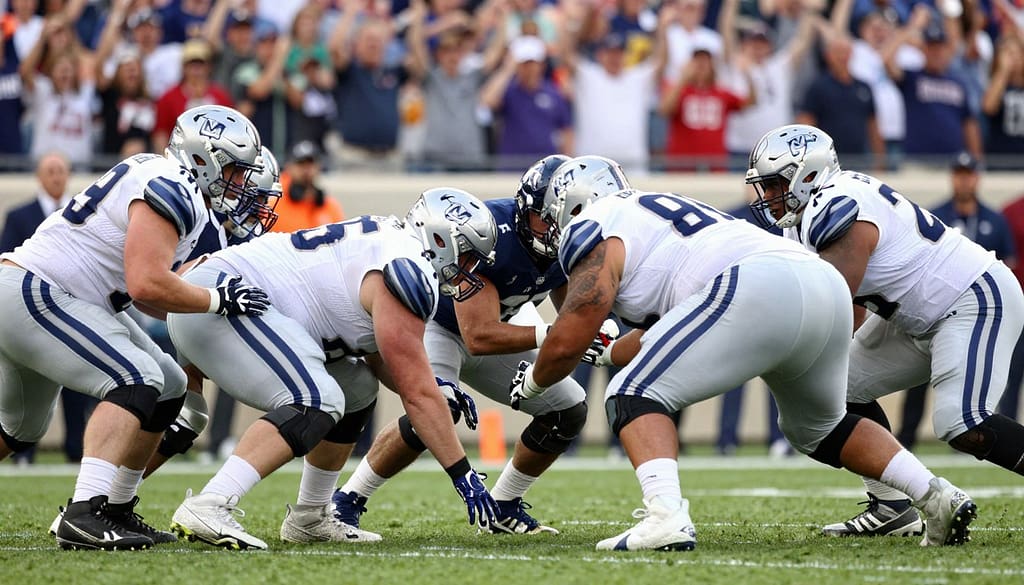
Michigan, where Texas is looking for new linemen, averaged 210.2 yards on the ground. They ranked 14th nationally in rushing. This shows a huge difference in how these teams approach running.
The low point was the Florida loss, where Texas managed only 52 yards rushing. This was like a performance about how bad they were at running. With holes in their line, they can’t run well. This makes them predictable and forces them to throw more.
This affects everything. It makes Arch Manning’s struggles clearer. A quarterback facing constant third-and-long is really handicapped.
| Team/Statistic | Rushing Yards/Game (2025) | National Rank | Yards/Carry |
|---|---|---|---|
| Texas Longhorns | 129.7 | ~100 | 3.8 |
| Michigan Wolverines | 210.2 | 14 | 5.1 |
| National Average (FBS) | 162.4 | N/A | 4.3 |
| SEC Average | 178.9 | N/A | 4.5 |
Look at that table. Texas was way below average. They were in a different league than the SEC. Running in the SEC is about being strong, not just fast.
What does this mean for upcoming SEC matchups? It means trouble. You can’t just outsmart a lack of strength. The run game is about physics, and Texas’s line isn’t strong enough.
Fixing this needs more than new players. It needs a change in mindset. The Longhorns must learn to move people against their will. Until then, every game will be tough. The trenches analysis is clear: you must control the line, or it will control you.
Pass-protection reliability
Twenty-three sacks allowed in a season is alarming. It’s a red flag for any offensive coordinator. For the 2025 Texas offensive line, this number was a timeline of pressure. It all came to a head in a disastrous game in Gainesville.
The Florida game was a six-sack horror show. Arch Manning, the program’s future, had to dodge rushers like a slasher film’s final girl. A quarterback hit can turn into “happy feet” and “panic.” It can make him see phantom pressure and mess up his timing.
The Pro Football Focus grades were brutal. They showed the line’s pass-protection skills were lacking. Only tackle Trevor Goosby and guard D.J. Campbell had grades above 70.0. Everyone else struggled to stay afloat.
This table shows the harsh reality. It reveals where the protection failed and who held the fort.
| Player (2025) | Position | PFF Pass-Block Grade | Sacks Allowed | Status |
|---|---|---|---|---|
| Trevor Goosby | Tackle | 74.2 | 3 | Returning |
| D.J. Campbell | Guard | 71.8 | 2 | Returning |
| Player A | Guard | 68.1 | 5 | Departed |
| Player B | Center | 65.4 | 4 | |
| Player C | Tackle | 62.0 | 6 | Departed |
Pass protection is about trust. The quarterback needs to trust his blind side. He needs to trust the A-gap won’t suddenly vomit a 300-pound defender into his lap.
Building that trust isn’t easy. It’s not just about finding big bodies. It’s about finding smart, agile technicians. Players who understand leverage and angles are crucial.
The transfer portal targets are a triage report. Texas needs tackles with a smooth kick-slide and guards who can anchor against a bull rush. Without this foundation, the entire offensive philosophy crumbles.
An attack built on timing and deep shots needs a clean pocket. Otherwise, it’s just a beautiful theory, gathering dust on a shelf. Looking at professional analyses of elite pass protectors shows the technical bar the Longhorns must reach. For this Texas offensive line, the path from liability to reliability is the single most important journey of the offseason.
Depth concerns
In the SEC football world, your bench is crucial. Losing it means you’re at a disadvantage. It’s not just about the starters. It’s about the players waiting to step in.
Christian Jones and Jake Majors are gone. They were key players. Kelvin Banks Jr. is left to carry the load. The losses don’t stop there.
DJ Campbell and Hayden Hutson played their last games. Neto Umeozulu has left for the portal. Cameron Williams might head to the NFL.
Connor Robertson might return. But his comeback is uncertain. Texas needs to replace most of its offensive line starters. This is a big challenge.
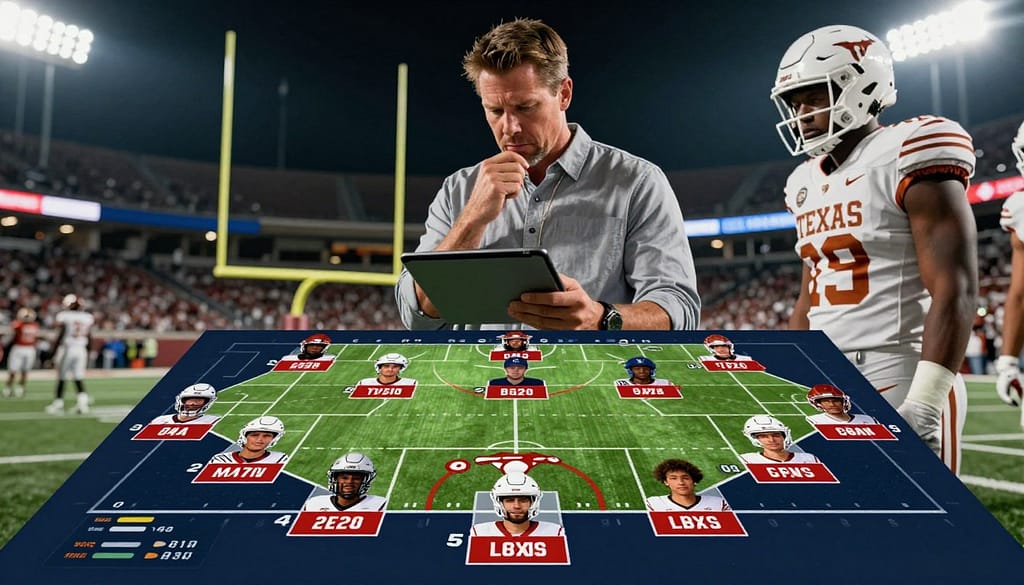
Steve Sarkisian wants “quality” over “quantity” in the transfer portal. This shows the team’s desperation. They’re looking for immediate help, not just any player.
Young talent offers hope. But it’s not enough. Nick Brooks and Daniel Cruz are promising. Brandon Baker, a top recruit, had a quiet first year. They could be the future.
But the SEC schedule is tough. It’s full of challenges. Without enough depth, you’re at risk of starting players who aren’t ready.
| Departing Lineman | 2023 Role | Potential Replacement | Experience Gap |
|---|---|---|---|
| Christian Jones (T) | Full-time Starter | Brandon Baker | Massive (0 starts vs. 40+) |
| Jake Majors (C) | Captain, Starter | Connor Robertson* | Significant (*if he returns) |
| DJ Campbell (G) | Key Starter | Neto Umeozulu | Major (now in portal) |
| Hayden Hutson (G) | Rotation/Starter | Daniel Cruz | True Freshman vs. Veteran |
| Cameron Williams (T) | Key Reserve | Nick Brooks | Limited Snaps vs. Game Experience |
The table shows a big problem. Every player who leaves creates a gap in experience. Texas is now very thin in the trenches.
Kyle Flood said it best. “If you recruit really good players, they may have options.” The portal can take away as well as give. You need to constantly find new players.
The real test isn’t in September. It’s in November. The SEC schedule is tough. Fatigue can be a big problem.
Without a strong two-deep, starters can’t rest. Their performance drops. The whole team suffers.
Right now, Texas’s depth chart is uncertain. Building a strong two-deep is a big challenge. Sarkisian’s search for “quality” in the portal is crucial for success.
SEC trench battles
The move to the SEC is like a physics lesson. Force equals mass times acceleration. Every defensive line is packed with future stars who are great at both.
Our trenches analysis faces its biggest challenge here. The Big 12 had technical battles. But the SEC is like weekly fights in a small space. That Florida game last season was just a taste of what’s to come.
Success depends on the Texas offensive line becoming a force to be reckoned with. You don’t need five All-Americans. What you need are five tough players who know a season can be won on a short run.
The Citrus Bowl against Michigan is a great warm-up. As mentioned in a season forecast, it’s a chance to show they’re a physical team. Can they run against a top front? Can they protect the quarterback?
The answers will shape the season. Every move, every new player, is for the SEC. The league’s truth is simple: control the trenches, or leave. The Texas offensive line is key to beating expectations.