
Let’s debunk a popular myth right away. The idea that any football coach arrives with a single, unchanging gospel of offense is not true. It’s as unlikely as a perfect bracket in March.
Steve Sarkisian himself admitted his Texas offensive scheme has evolved “more than people would want to admit.” This shows us the first core concept: adaptability is key, not just a feature.
At first, the Longhorns’ approach was simple. It was like a ground-and-pound opera starring Bijan Robinson. The strategy was old-school: start with the run, then take smart shots downfield.
But what if the script changes? Or the players do? The playbook gets updated.
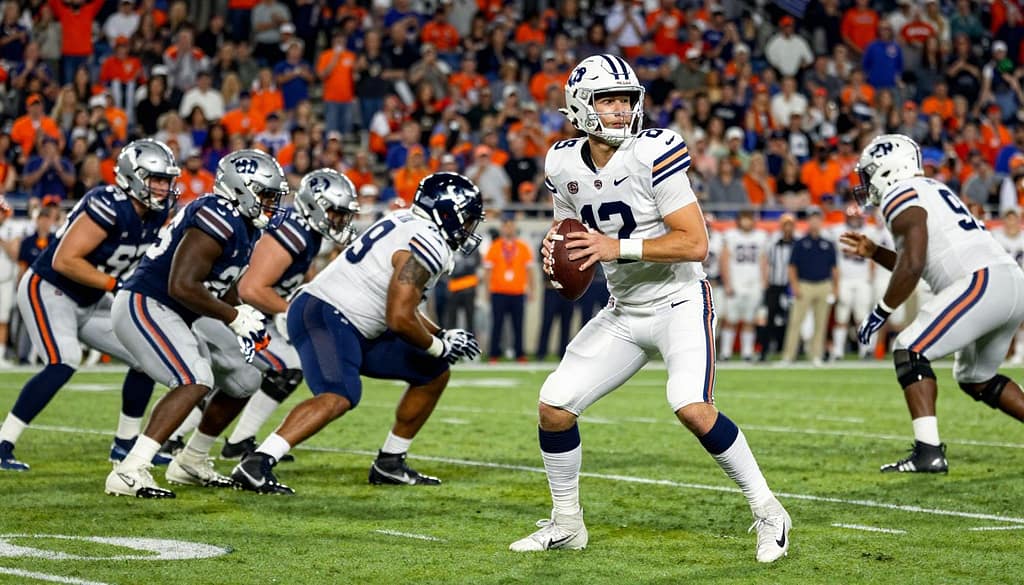
Now, the Texas offense strategy is more like a psychological thriller. We use empty sets and spread formations to mess with defensive spacing before the snap. It’s a game of chess, where alignment and tempo are our weapons.
This change shows the constant battle in modern football. Offense and defense keep finding new ways to outsmart each other. The real core concept is always looking for a tactical advantage.
Personnel fit
Steve Sarkisian’s offense has seen more staff changes than a White House press secretary. Yet, the message stays the same. Think about that for a second. When Bijan Robinson and Roschon Johnson left for the NFL, it was more than just a running back spot open.
It was like losing two main actors from a hit show.
The script needed rewrites. The entire offensive identity had to evolve.
Enter the coaching carousel. Stan Drayton out, Tashard Choice in, then Chad Scott from Neal Brown’s world. At receiver, Andre Coleman was replaced by Brennan Marion, known for “Go-Go” plays. Then, Brennan Marion handed it to Chris Jackson, an NFL player. This isn’t random musical chairs. It’s strategic casting.
Chad Scott brings Appalachian power to the run game. Chris Jackson teaches professional precision in the receiver room. They’re not changing the language of the Sarkisian offense. They’re becoming dialect coaches for the same playbook. This is the subtle genius often missed in college football.
Continuity of message amidst churn of messengers. The system provides the grammar, but the coaches provide the local idioms.
What does this mean on the field? The early Sarkisian script was written for specific stars. When the casting changed, concepts were adapted. The framework isn’t a straitjacket. It’s a canvas. The art lies in finding the overlap between a quarterback’s arm talent, a receiver’s route tree, and a running back’s vision.
Then you design plays that make them sing in harmony. This adaptability extends to using 12 personnel packages effectively, creating mismatches that unlock defensive schemes.
The myth of “plug-and-play” systems is fan fiction. The reality is a constant, witty negotiation. What do you want to run versus what can your current guys run brilliantly? The Sarkisian offense answers that question not with dogma, but with fluid design.
It’s less about finding players for your system. It’s more about tailoring your system to maximize the players you have. That’s the real personnel fit. That’s how you survive staff turnover and roster evolution while keeping your offensive identity intact.
Tempo and spacing
The modern Texas offensive scheme is simple yet scary. It’s not about complex plays. It’s about making the defense reveal its strategy first.
Last season, Texas changed its game plan. They used spread and empty sets to outsmart defenses. This move was a smart use of geometry to weaken the defense.
Spacing is not just about players being far apart. It’s about creating areas where the defense is weak. Think of it like a sculpture, where empty space is just as important as the filled parts.
Tempo is also key. It’s not just speed. It’s about controlling the game’s pace. A quick snap after a big play is a mental attack. It keeps the defense off balance.
This strategy turned a weakness into a strength. With a light box, the quarterback can run effectively. With a heavy box, the quarterback has five receivers to choose from. The defense is always on the back foot.
To grasp this strategy, learn about tempo mechanics. This system is all about outsmarting the defense. One small mistake by the defense can lead to a big win for Texas. That’s the power of tempo and spacing.
SEC defensive challenges
In the SEC, every defensive coordinator is a master of disruption. It’s like a faculty meeting where the topic is pain. For the Texas offense strategy, moving from the Big 12 to this is a big change.
The conference’s coaching roster is full of defensive geniuses. Playing Georgia is like trying to solve a complex algorithm. Brian Kelly at LSU is known for his talent and efficiency. He even poached Texas’s defensive line coach, Bo Davis.
Then there’s Lane Kiffin at Ole Miss and Mike Stoops at Kentucky. They’re not just opponents; they’re ideologies with whistles. They use complex strategies and physical football.

So, what does this mean for Sarkisian’s scheme? The wide-open spacing won’t work as well against SEC defenses. They’ll try to take away your favorite play on every snap.
This is where offensive philosophies are tested. Can a spread system survive in these dense defenses? The Longhorns must adapt to win in the mud, not just on the fast track.
Every week is a new challenge. It could be Alabama’s physicality or Tennessee’s scheming. It’s a weekly grind that tests vs sharpshooting offenses separates contenders from pretenders.
The Texas offense strategy must become practical. It’s not just about scoring. In the SEC, it’s about surviving. The offensive line becomes a bunker, and the quarterback’s reads are crucial.
Welcome to the peer review. Your dissertation on offense is due every Saturday, and the professors grading it have no mercy.
Tactical evolution
When an offense stops asking questions, it becomes predictable. The Sarkisian offense avoids this trap. It’s always in a state of improvement, like a tech startup in beta.
Pete Kwiatkowski’s defense also evolved. It changed from quarters to man-free, taking in Duane Akina’s single-high wisdom. Akina teaches many ways to play defense, not just one. This makes the defense flexible.
Sarkisian’s real strength might be in management. He keeps the team consistent while bringing in top talent. He’s always looking for the next big thing, like Kenny Baker or Johnny Nansen. The system’s power comes from its ability to create new plays.
This approach benefits the team on the field. True balance in offense means attacking everywhere. The Sarkisian offense uses tempo changes, different players, and smart matchups. It’s like the weekly adaptations tracked by experts.
The ultimate goal isn’t a specific formation. It’s a philosophy of constant adaptation. The playbook is always changing. The aim is to keep the opponent guessing, always solving for a new problem.