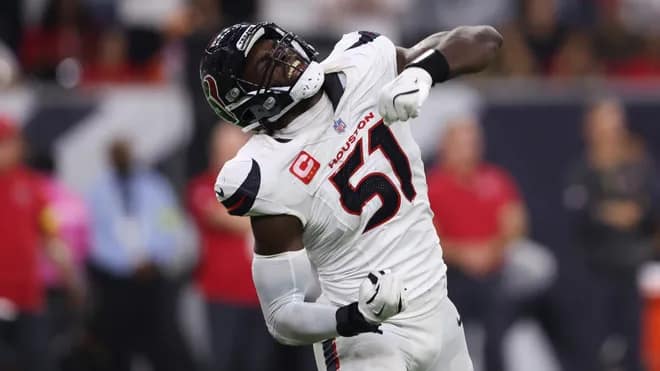
The timing tells the story. In the NFL, teams usually hand out market-shifting contracts either out of urgency or conviction, and the Houston Texans just made it clear which side they are on. By locking in Will Anderson Jr. to a massive new deal days before the draft, Houston is sending the strongest possible message: this roster is no longer being built around desperation, but around advantage.
I see this move as more than a reward for an elite young pass rusher. It is a declaration that the franchise believes its foundation is set, its competitive window is open, and its next step is refinement rather than rescue. That is a very different place from where the Texans stood not long ago, and it changes the way the entire offseason should be read.
A Franchise Cornerstone Gets Paid
Houston’s agreement with Anderson on a three-year, $150 million extension, including $134 million guaranteed, lands with the force of a franchise-defining decision. The money alone places him in rare territory. The structure matters even more. Guarantees at that level are reserved for players an organization believes can anchor not just a defense, but an era.
Anderson has earned that belief. He plays the premium position every front office covets, and he does it with the sort of complete disruption that changes games before the stat sheet fully explains it. Edge rushers who can consistently alter protection plans, compress pockets, and force offenses to speed up their process are among the league’s most valuable assets. Houston has one, and now Houston has ensured that asset remains central to its identity.
This is what mature roster building looks like. Elite teams do not hesitate when the right player reaches the right moment. They identify the foundational piece, absorb the cost, and keep the prime years under team control. That is exactly what the Texans have done here, and it should be read as a sign of institutional confidence.
For a franchise that spent years cycling through uncertainty, this extension marks a sharp break from the past. It says Houston is no longer trying to discover who it is. The Texans know.
Why The Deal Matters Beyond The Defense
The obvious interpretation is that Houston is paying to preserve its pass rush. That is true, but it is only the beginning. What stands out to me is how this contract reorganizes the broader conversation around the team.
A move like this does not happen in a vacuum. It happens when a front office believes the premium dollars are going to the right player at the right time because the rest of the roster can support it. That matters just as much as the deal itself. Houston is not spending like a team plugging leaks. It is spending like a team that sees its ceiling and wants to raise it.
That distinction becomes especially important with the draft approaching. The Texans are entering this next phase without the pressure that typically distorts team-building decisions. They do not need to reach for an immediate savior. They do not need to talk themselves into a prospect because the depth chart looks alarming. They can survey the board with the calm of a roster that already has significant pieces in place.
In practical terms, that is one of the greatest advantages any team can carry into draft week.
The Draft Changes When Need No Longer Controls You
The most revealing part of Houston’s current position is not the extension itself. It is what the extension reinforces: the Texans appear to believe they can add talent rather than chase glaring holes. That is a critical distinction, and it changes the quality of decision-making.
Teams drafting from need often trap themselves. They reach for scheme fits, elevate flawed prospects, and overpay in draft capital simply to address immediate discomfort. Teams drafting from strength tend to do the opposite. They let value come to them. They choose upside over panic. They allow the roster to become more layered and more resilient.
That is where Houston now seems to be.
The trenches remain a sensible focal point, not because the Texans are in crisis there, but because the smartest contenders keep feeding their lines. The NFL still runs through pass protection, pass rush, and the ability to win late in games when everyone in the stadium knows what is coming. Houston’s approach suggests a team looking to fortify the structural elements that sustain winning in January, not just the cosmetic parts that generate offseason praise.
Here is where the Texans appear to stand entering the draft:
| Area | Current Outlook | What It Means For Houston |
|---|---|---|
| Edge Rush | Anchored by Will Anderson Jr. | Houston can build around elite pressure rather than search for it |
| Defensive Identity | Clear and aggressive | The roster now supports continuity instead of reinvention |
| Draft Strategy | Flexible, value-oriented | The Texans can target best-player opportunities |
| Trenches | Still worth reinforcing | Depth and long-term durability remain priorities |
| Competitive Window | Open now | Moves can be made with contention in mind |
That table captures the larger point: this is a team with the luxury of optionality. In the NFL, optionality is power.
What The Texans Are Really Buying
When people see a number like $150 million, the first instinct is to debate whether any defender is worth that kind of commitment. I think that question misses the more important one. What exactly is Houston buying?
The Texans are buying predictability at a premium position. They are buying a young player whose impact shows up snap after snap. They are buying credibility in their own building. And they are buying a version of roster construction that is much harder to achieve than it sounds: keeping elite talent in-house before it becomes someone else’s bidding war.
They are also buying continuity. That matters more than many teams admit. A defense with a true star off the edge can be designed more aggressively. Coordinators can call games with more confidence. Coverage can tighten because the rush arrives on schedule. Complementary defenders benefit because offenses slide protection, alter launch points, or commit extra help. The star’s value extends well beyond his own production.
That is why a contract like this tends to ripple across the team. It is not just a cap commitment. It is a competitive statement.
For readers tracking the broader Houston Texans, this extension serves as a clean marker of where the franchise is in its arc. Houston is no longer introducing itself to the league. It is trying to establish permanence.
Why The Timing Before The Draft Is So Important
The calendar matters as much as the contract. Doing this before the draft frames the Texans’ next moves in a specific way. It reduces noise, clarifies priorities, and tells the rest of the league that Houston is operating from a position of internal certainty.
I think that matters in three ways:
- It stabilizes the franchise narrative before draft week.
- It allows the front office to approach the board without contract uncertainty hanging over a cornerstone player.
- It reinforces to the locker room that elite performance will be recognized and retained.
Those are not minor benefits. They shape culture, leverage, and decision-making all at once.
The timing also prevents the draft from becoming overloaded with expectation. Houston does not need one weekend to define its future. That alone is a sign of progress. Franchises in trouble always treat the draft as a lifeline. Franchises on the rise treat it as an accelerator.
The Texans look much closer to the second category now.
Houston’s Window Looks More Real Than Symbolic
There is always a stage in a team’s climb when optimism is easy but proof is still thin. Houston is moving beyond that stage. The combination of roster confidence and financial commitment to a premier defender suggests a front office that believes contention is not abstract. It is tangible.
That does not mean the Texans are finished. No serious team is ever finished. The draft still matters. Depth still matters. Injury insurance, line play, and roster balance still matter. But the key difference is that Houston is now addressing those questions from a place of strength instead of instability.
That is the most meaningful shift any franchise can make.
What I find most compelling about this moment is that it is not built on noise. It is built on structure. A team that knows its stars, understands its timeline, and enters the draft with flexibility is a dangerous team. Houston now checks those boxes.
Why This Matters Right Now
This matters right now because the Texans have crossed from rebuilding language into contender behavior. The Will Anderson Jr. extension is not just a contract headline; it is a signal that Houston sees itself as a team with real staying power, not a brief surge of promise.
And with the draft days away, that matters even more. The Texans are no longer shopping for emergency answers. They are positioning themselves to make sharp, disciplined choices that strengthen a roster already built around premium talent. In today’s NFL, that is how serious teams separate themselves, and Houston just made it clear it intends to be one of them.