
Texas has spent years building toward SEC readiness, but the clearest shift in perception has come from one position group above all others.
The defensive line.
Recent recruiting momentum, highlighted by the addition of Tyler Alexander (Palm Beach Central High School, Wellington, Florida) and other high-priority interior targets in the 2027 cycle, signals a structural change in how Texas approaches roster construction. The Longhorns are no longer recruiting defensive linemen as complementary pieces. They are prioritizing them as foundational assets.
That shift is altering how the SEC views Texas entering future seasons.
Programs that consistently contend in the conference—Georgia, Alabama, LSU—have long relied on defensive fronts capable of controlling games against elite offensive lines. Texas is now building toward that same model with increasing consistency.
Recruiting trends from the past month reflect a clear direction: Texas is attempting to reshape its identity through the trenches.
The Interior Defensive Line Has Become Texas’ Recruiting Priority
The commitment of Tyler Alexander was not an isolated win. It reflects a broader strategy that has developed across multiple recruiting cycles.

At 6-foot-3 and over 300 pounds, Alexander represents the type of interior presence Texas has targeted more aggressively in recent months. His recruitment included strong competition from programs such as Georgia, Notre Dame, and Colorado, all of which have built reputations on defensive line development.
Texas winning that battle signals a change in perception.
Interior defensive linemen of Alexander’s profile rarely choose programs without a clear development plan and early playing pathway. His decision suggests confidence in both the coaching staff and long-term defensive structure being built in Austin.
Recent recruiting analysis from national outlets such as 247Sports recruiting rankings continues to place a premium on interior defensive linemen, particularly for programs competing in physically demanding conferences like the SEC.
Texas has responded by aligning its recruiting priorities with that reality.
Rather than relying on portal additions to patch interior gaps, the Longhorns are investing early in high-upside developmental prospects who can grow into multi-year contributors.
Kenny Baker’s Role In Building Defensive Recruiting Momentum
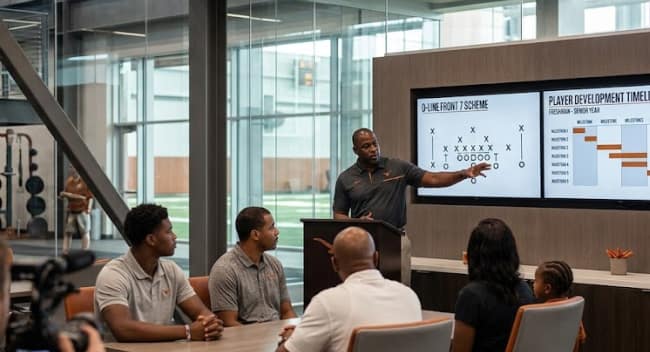
Texas defensive line coach Kenny Baker has emerged as a central figure in the program’s recruiting surge.
His approach centers on long-term development planning and relationship-driven recruiting. That combination has resonated with defensive prospects evaluating programs across the country.
In Alexander’s recruitment, Baker’s influence was evident throughout the process.
Recruiting success at this level rarely depends on a single visit or pitch. It often comes from sustained communication, trust-building with families, and a clear explanation of how a player fits into a defensive system over multiple years.
Texas has leaned heavily on that structure.
Baker’s ability to position Texas as a destination for interior defensive linemen is reshaping how prospects view the program. The Longhorns are no longer viewed primarily as an offensive-driven program. Defensive recruits increasingly see Austin as a viable development path for NFL-level interior linemen.
That perception carries weight in national recruiting battles.
Programs like Georgia have built defensive identities over years of consistent recruiting success up front. Texas is attempting to compress that timeline through targeted recruiting wins and staff continuity.
External recruiting coverage from On3 has noted that Texas is among the programs gaining traction with interior defensive prospects in multiple regions, particularly in Florida and the Southeast.
That geographic expansion is directly tied to coaching relationships and recruiting infrastructure.
Florida Has Become A Key Pipeline For Texas Defensive Talent
One of the most significant developments in Texas recruiting strategy is the increasing presence in Florida.
Tyler Alexander is part of a growing list of defensive line prospects from the state who have shown strong interest in Texas or already committed to the program. Florida remains one of the most talent-dense regions in the country, producing elite defensive linemen across multiple recruiting cycles.
Texas’ success in the region signals a shift beyond traditional recruiting boundaries.
Competing in Florida requires overcoming established regional powers such as Miami, Florida State, and SEC programs with long-standing pipelines in the state. Texas entering and winning those battles changes how national recruits evaluate the program’s reach.
The Longhorns now present a clear argument to Florida prospects: development in Austin leads to SEC exposure and NFL opportunity.
That message has gained traction in recent recruiting cycles.
Texas Defensive Line Recruiting Focus Areas
| Area | Recruiting Objective |
|---|---|
| Interior Defensive Tackles | Control run game in SEC matchups |
| Edge-Interior Hybrid Players | Increase schematic flexibility |
| High-Upside Development Prospects | Long-term roster building |
| Florida Pipeline Recruits | Expand national recruiting reach |
| Physical Prototype Linemen | Match SEC trench standards |
This structure reflects a deliberate shift in roster construction philosophy. Texas is prioritizing players capable of developing into multi-year SEC contributors rather than short-term rotational pieces.
That approach mirrors strategies used by programs with sustained success in the conference.
The emphasis on Florida recruits, in particular, has created new recruiting momentum that continues to expand beyond state borders.
Defensive Line Depth Now Defines SEC Expectations
The SEC has long been defined by trench play.
Recent championship teams have consistently featured defensive lines capable of sustaining pressure over four quarters against elite offensive fronts.
Texas is adjusting its recruiting strategy with that reality in mind.
Rather than treating defensive line recruiting as one part of a broader class, the Longhorns have elevated it into a central pillar of roster construction.
This shift is influencing external expectations.
Analysts evaluating Texas’ future SEC competitiveness increasingly point to defensive line depth as a key indicator of readiness. Without consistent interior disruption, even high-powered offenses struggle to maintain balance in conference play.
That reality explains why recruiting wins like Alexander’s carry weight beyond rankings.
The ability to attract and sign multiple high-level defensive linemen in a single cycle creates structural advantages that compound over time.
Texas is now building toward that type of roster depth.
Recent coverage of SEC football competition continues to highlight trench play as the defining factor in championship outcomes, reinforcing the importance of Texas’ recruiting focus.
Texas Is Shifting From Talent Acquisition To Structural Roster Design
The broader story behind the defensive line recruiting surge is not simply about individual commitments.
It reflects a shift in how Texas constructs its roster.
Earlier recruiting cycles often emphasized high-profile skill position additions and overall class rankings. The current approach shows a more balanced structure, with equal emphasis on both offensive and defensive fronts.
Defensive line recruiting now sits at the center of that evolution.
Alexander’s commitment represents a prototype of the type of player Texas is targeting: physically developed, high-ceiling prospects capable of anchoring a defensive front in SEC competition.
That direction suggests long-term planning rather than short-term roster filling.
It also indicates confidence in player development infrastructure under the current coaching staff.
The Longhorns are not only recruiting talent. They are recruiting fit, long-term projection, and SEC adaptability.
That shift is already influencing perception across the conference.
Opponents preparing for future Texas teams will not only face elite offensive talent. They will also contend with defensive fronts built to match the physical demands of SEC play.
The foundation for that change is already visible in the 2027 recruiting cycle.