
Think of modern roster building like a blockbuster film. It starts with a big, exciting trailer, not the credits.
The most dramatic portal impact isn’t about depth. It’s like emergency surgery for a team with a big hole. The team is ready to make a bold move.
In Austin, the running back room needs a star. A great bowl game performance wasn’t enough. Now, they’re looking for a proven player from Louisville and a promising talent from Florida. This is a serious search for the right player.
In Lubbock, Texas Tech didn’t hesitate when their quarterback got hurt. They found a new quarterback with amazing skills. This player could be a top pick in the draft.
These big moves get everyone talking and change the odds right away. They answer the big question: “Who’s playing next season?” It’s all about quick, exciting changes.
Depth reinforcement
If the transfer portal were a Hollywood blockbuster, the depth reinforcements would be the character actors who steal every scene they’re in. They don’t get the opening credits, but the film falls apart without them. Texas Tech’s 2026 approach exemplifies this perfectly.
Look past quarterback Taylen Sorsby in Lubbock, and you’ll find a masterclass in roster archaeology. The Red Raiders aren’t just shopping for stars—they’re unearthing gems.
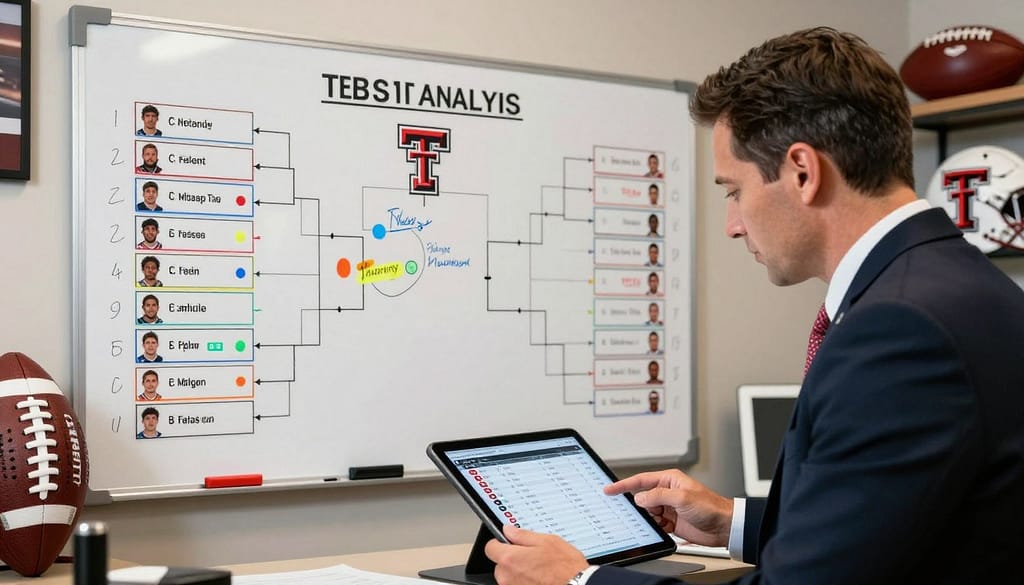
Take wide receiver Jalen Jones. Coming from Alabama State (FCS), his yards-per-route-run metrics placed him in elite company nationally. He’s a calculated bet on proven production in a lower-visibility market. Then there’s cornerback Davin Martin from UTSA, who played 248 coverage snaps last season without allowing a single touchdown.
These aren’t household names. Yet. They’re the equivalent of a savvy GM finding a future All-Pro in the fifth round of the NFL draft. This is where the portal impact gets surgical.
Texas Tech’s haul extends well beyond those two. The class is a comprehensive depth injection across key position groups, as detailed in their 2026 portal class analysis. Each addition addresses a specific need with a player who has already produced elsewhere.
| Position | Player | Previous School | Key Attribute |
|---|---|---|---|
| Wide Receiver | Jalen Jones | Alabama State | Elite efficiency metrics (YPRR) |
| Wide Receiver | Donte Lee Jr. | Liberty | Size and red-zone threat |
| Defensive Line | Trey White | San Diego State | Run-stopping anchor |
| Defensive Line | Bryce Butler | Washington | Pass-rush versatility |
| Defensive Line | Julien Laventure | Akron | Interior disruption |
| Linebacker | Austin Romaine | Kansas State | Big 12 experience and tackling |
| Cornerback | Davin Martin | UTSA | Elite coverage (0 TDs allowed) |
In Austin, the Longhorns show that the portal impact isn’t just about who you bring in. Sometimes, it’s about who you keep to develop what you already have.
Locking down wide receivers coach Chris Jackson to a new deal is a portal move of a different kind. Call it a portal for knowledge and development. Jackson’s resume is a receiver’s dream: he helped mold Xavier Worthy and Adonai Mitchell into first-round NFL picks.
His current projects include highly-touted recruits like Ryan Wingo and Parker Livingstone. Jackson’s continued presence ensures that every pass-catcher in Austin—whether a blue-chip freshman or a Texas transfer—has a direct pipeline to NFL-level coaching.
Think of it this way. The portal giveth raw talent. A coach like Jackson teacheth it how to dominate. This is the ultimate, sustainable depth reinforcement.
The contrast in philosophy is fascinating. Texas Tech aggressively mines the portal for ready-made, under-the-radar contributors. Texas invests in the institutional knowledge to maximize every player on its roster. Both are valid strategies for managing the modern portal impact.
For programs navigating the constant churn of Texas transfers and national movement, this dual approach might be the new blueprint. Secure your immediate needs with proven commodities. Then, protect your long-term development engine at all costs.
The real chess move isn’t just landing the queen. It’s ensuring every pawn on the board is a potential game-winner. That’s depth.
Chemistry risks
Coaches are playing fantasy football with the portal, but they’re risking something more important. They’re playing with the team’s unity. This unity can’t be measured, but it’s crucial for the team to work together.
The portal impact is big in the team’s psychology. When a player like Louisville’s Isaac Brown joins with a “do not contact” tag, it sends a message. This tag is like skipping the courtship, which is important for building trust.
This message affects the players already in the team. The portal impact isn’t just about adding talent. It’s also about managing the team’s egos and expectations.
Every transfer comes with baggage. Brown’s four career fumbles are a known issue. Texas coaches are getting his speed but also a problem with ball security.
Scale makes the risk even bigger. Texas Tech took 21 transfers last cycle. That’s almost two full starting lineups of new players.
Imagine the first team meeting with 21 new faces. It’s hard to build trust quickly. The fast pace of the NCAA transfer portal doesn’t help.
Building a team is a delicate balance. The portal can fix problems quickly. But team culture takes time and shared experiences.
You can quickly gather talent. But building unity takes years. The most successful Texas transfers will be those who embrace the team’s identity.
Without unity, even talented players can’t work well together. The stats might look good, but the real test is in November, when things get tough.
The portal impact has a long-lasting effect. Chemistry is the most unpredictable part of building a team.
Long-term roster planning
The smartest programs don’t just react to the portal. They build a system around it. Think of it like chess, not checkers.
Texas locking in GM Brandon Harris and coach Chris Jackson isn’t just office news. It’s a statement. It’s the “Retain” pillar of a three-part strategy: Develop, Retain, Acquire. This stability lets you use the portal as a scalpel, not a sledgehammer.
Look at Texas Tech. They’re chasing portal stars while boasting a top-20 high school class. That’s the model. You reload for today with targeted Texas transfers while building for 2027 with teenagers.
So this running back search? It’s not panic. It’s a precise adjustment. The portal impact is measured by how it extends a championship window, not just fills a roster spot.
The sage knows true power is in the long game. The programs that win will treat the portal as one variable in a much larger equation for lasting success.