The timing could not be more consequential for Texas A&M. What should have been a routine spring showcase instead became the kind of moment that instantly changes the tone of an offseason, forcing coaches, players, and fans to confront a familiar truth about college football: momentum can shift in a single snap.
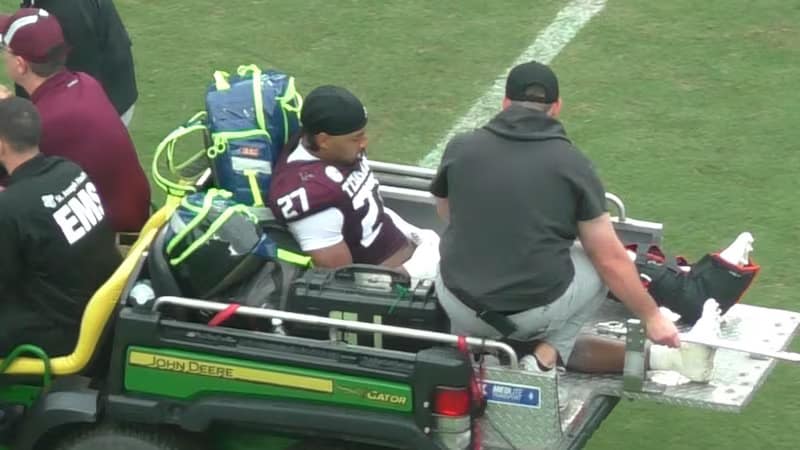
I view the latest development around the Texas A&M Aggies as more than an unfortunate spring injury. Daymion Sanford being carted off with a lower-body issue during the Maroon & White game, followed by the early end of the event, has pushed one question to the center of the program’s 2026 outlook: how sturdy is this defense if one of its veteran anchors is suddenly unavailable?
Why This Spring Game Suddenly Mattered More Than Expected
Spring football is usually sold as a preview. Coaches want live reps, young players want exposure, and fans want a first look at how the roster is taking shape. In practice, though, spring games often function as controlled optimism. They are designed to showcase possibilities without fully exposing flaws.
That is why this moment landed so heavily.
Sanford’s injury disrupted more than the flow of one scrimmage. It changed the emotional and strategic meaning of the day. Once a veteran linebacker goes down badly enough to be carted off, the atmosphere changes immediately. The scoreboard no longer matters. The playbook becomes irrelevant. The only thing that counts is the health of the player and the effect his absence could have on a unit expected to carry a serious share of this team’s burden in 2026.
For Texas A&M, linebacker is not a decorative position. It sits at the center of everything a modern SEC defense must do well. The role demands range, communication, discipline against the run, and the ability to survive in space against tempo offenses. A senior player at that spot is supposed to bring more than tackles. He brings order.
That is why this injury has such a wide ripple effect.
Daymion Sanford’s Importance Goes Beyond The Depth Chart
When I assess an injury in April, I try to separate the immediate concern from the long-term structural concern. The immediate concern is obvious: a lower-body injury for a linebacker can affect availability, mobility, conditioning, and readiness for camp. The deeper concern is what it reveals about how dependent a defense may be on veteran steadiness.
Sanford’s value is likely measured in more than production. Senior defenders often serve as the connective tissue of a unit, especially in spring, when lineups are unsettled and younger players are still learning how to process college-level speed. A veteran linebacker helps align fronts, calm confusion before the snap, and close the space between talent and execution.
If he misses meaningful time, Texas A&M is not just replacing a body. It may be replacing command.
That matters because defenses rarely break down only because they lack athleticism. They break down because they hesitate, misread, overrun plays, or fail to communicate adjustments. The experienced player in the middle of the formation often prevents those errors before they ever become visible to the crowd.
The Early End To The Maroon & White Game Sent Its Own Message
The decision to end the spring game early was a signal in itself. Programs do not cut these events short lightly. Even when spring games are heavily managed, they still serve recruiting, fan engagement, and internal evaluation purposes. Ending the event underscored the seriousness of the moment and the emotional weight inside the stadium.
That kind of decision also reveals a broader shift in how major programs now treat spring football. The old model prized spectacle and toughness. The newer model prioritizes roster preservation. Coaches know they are operating in an era defined by transfer movement, playoff pressure, and thin margins. A spring injury to a key veteran is no longer shrugged off as part of the game. It is treated as a potential turning point.
Texas A&M’s reaction reflected that reality.
What This Means For The Aggies Defense
The most immediate football consequence is straightforward: every defensive projection now comes with an asterisk until Sanford’s condition is clearer. That uncertainty places extra attention on position depth, contingency planning, and player development over the next several months.
Here is where the issue becomes more instructive than dramatic. A contender is not defined by whether it avoids setbacks in spring. It is defined by how well it absorbs them.
The Aggies now have to answer several practical questions. Can younger linebackers handle expanded responsibility? Is there enough versatility in the front seven to compensate if experience is reduced in the middle? Can the staff reshape responsibilities without weakening run fits or pass coverage integrity?
Those are not spring hypotheticals anymore. They are live roster questions.
Defensive Pressure Points After Sanford’s Injury
| Area | Why It Matters Now | Potential Impact |
|---|---|---|
| Linebacker Communication | The middle of the defense organizes fronts and checks | More missed assignments if experience is limited |
| Run Defense | SEC offenses test discipline and tackling depth | Greater strain on interior defenders |
| Third-Down Coverage | Linebackers must diagnose quickly in space | More vulnerability against tempo and mismatch concepts |
| Leadership | Veteran presence matters during camp and early season prep | Younger players may be pushed into faster development |
The table is useful because it clarifies the scope of the issue. This is not just about one position on a participation chart. It touches the mechanics of how a defense functions.
Spring Injuries Always Test The Story A Program Tells About Itself
Every offseason, programs talk about competition, development, toughness, and depth. Spring is where those claims are lightly tested. Injuries are where they are seriously tested.
Texas A&M now faces one of those truth-revealing moments.
If the staff has built real depth, this injury becomes disruptive but manageable. If the linebacker room is less settled than expected, the consequences could linger into August and reshape how the defense is installed for the season. Coaches may need to simplify roles, accelerate younger players, or redistribute responsibilities to avoid exposing one weak point too early.
I think this is why the Sanford injury resonates beyond one afternoon. It forces the Aggies to confront the difference between theoretical depth and usable depth. Those are not the same thing. A player can look promising in rotational spring reps and still be unready to handle the pace, volume, and decision-making load of a high-stakes SEC game.
That distinction becomes brutally clear when a veteran goes down.
The Emotional Cost Can Be Real, Too
Football analysis often reduces injuries to charts, reps, and scheme. But spring injuries also carry a psychological cost, especially when they happen to older players. Teammates know what a senior has invested. Coaches understand what a final year is supposed to represent. Fans sense the shift instantly.
The emotional effect on a team should not be overstated, but it should not be ignored either. A spring camp that began with momentum can suddenly feel fragile. Urgency replaces curiosity. Evaluation turns into damage control. The room starts thinking less about upside and more about preservation.
For a program trying to build continuity and confidence, that matters.
What I’ll Be Watching Next
The next phase of this story is not about emotion. It is about response. A few specific developments will determine whether this remains a concerning spring episode or becomes a defining offseason obstacle:
- The clarity and timeline around Sanford’s lower-body injury
- Which linebackers begin taking more prominent reps in the aftermath
- Whether Texas A&M adjusts its defensive installation to reflect less veteran certainty
- How much confidence the staff signals publicly and structurally at the position
Those details will shape how the Aggies are viewed heading into summer.
Why This Matters Right Now
Spring football usually invites projection. This injury demands evaluation. Texas A&M had a chance to spend April selling possibility; instead, it must now prove resilience.
That is why this moment matters right now. A veteran linebacker being carted off during the spring game is not just a troubling visual or a short-lived headline. It is a stress test for the roster, a challenge to the defense’s internal structure, and a reminder that the path to relevance in college football is often defined not by star power alone, but by how well a program handles sudden instability. For the Aggies, the offseason has changed tone, and the next answers they provide will say far more than the spring game ever could.