
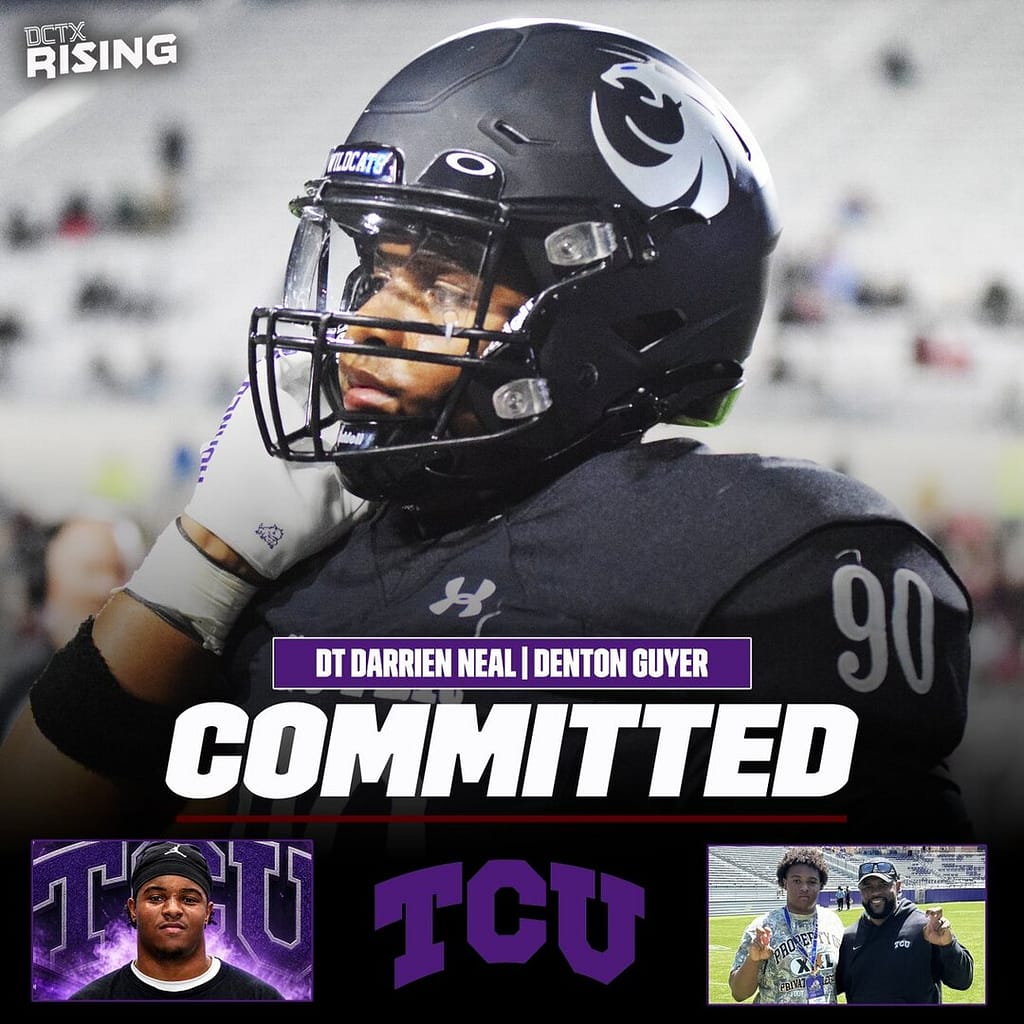
Darrien Neal TCU Commitment news matters because early defensive line wins often reveal more about a program’s direction than a single headline ranking ever can. TCU did not just add a 2027 three-star from Denton Guyer; it secured a local defensive piece with Power 4 interest at a moment when Sonny Dykes’ future roster build needs more size, more depth, and more force up front.
Why The Darrien Neal TCU Commitment Matters
The first mistake with a 2027 commitment is treating it as distant background noise. Yes, Neal is early in the process compared with players who will sign sooner, and plenty can change before a recruit reaches campus. But the broader signal is worth reading: TCU is already working ahead in a class that will help define the next version of the Horned Frogs.
Darrien Neal is listed as a 6-foot-3, 275-pound defensive lineman from Denton Guyer, one of the stronger high school programs in North Texas. He picked TCU over multiple Power 4 options, giving the Horned Frogs a local win that carries more value than the star count alone. In a recruiting market where defensive linemen with real frames are pursued aggressively, getting an early commitment from a player in the Metroplex is not a small thing.
The Darrien Neal TCU Commitment also fits the direction TCU has to take if it wants to keep climbing. Offensive identity has never been the concern around Dykes’ program. The more important long-term question is whether TCU can build enough defensive stability to survive the weekly demands of Big 12 football.
The Local Recruiting Angle Is The Real Story
Neal being from Denton Guyer matters. TCU does not need to win every North Texas recruitment, but it does need to be a constant presence when local Power 4-caliber prospects begin making serious decisions. Fort Worth sits in one of the richest football regions in the country. If the Horned Frogs cannot consistently turn proximity into leverage, they leave too much opportunity on the table.
Local recruiting is not only about mileage. It is about relationships, trust, evaluation frequency, and the comfort of families who can see the program without turning every visit into a major trip. Denton to Fort Worth is close enough for TCU to stay familiar, but the Horned Frogs still had to beat programs with their own pitches, resources, and defensive needs.
That is why Neal’s choice feels like a useful early commitment. TCU did not merely benefit from geography. It converted geography into commitment. The modern recruiting map punishes passive programs.
If a staff waits for a prospect to become nationally obvious, the price of the recruitment rises quickly. TCU’s better path is to identify traits early, build comfort, and sell a role before the market becomes crowded beyond control. Neal’s pledge suggests that approach still has real credibility and timing.
What Neal Brings To The Defensive Front
The appeal begins with body type. A 6-foot-3, 275-pound defensive lineman gives a college staff developmental flexibility. Depending on growth, technique, and conditioning, Neal could project into multiple interior-front possibilities rather than a narrow role. That kind of frame gives coaches options, and options create depth.
There is also the Denton Guyer context. Prospects from established Texas high school programs often arrive with a sharper understanding of competition, preparation, and expectation. That does not guarantee college success, but it lowers some of the mystery. Neal has been in a football environment where standards matter, and that background can support the transition into a college defensive room.
A public recruiting profile can only tell part of the story, but the available information around the Darrien Neal recruiting profile gives enough to understand why TCU wanted him early. The Horned Frogs are not simply collecting bodies. They are trying to add a defensive lineman with size, regional fit, and the developmental runway to become more than an emergency depth piece.
For defensive tackles and interior linemen, the jump from high school to college is rarely instant. Strength, hand usage, pad level, block recognition, and stamina all have to mature. That is why early commitments at the position are best understood through projection, not immediate certainty.
A Useful Snapshot Of The Commitment
| Category | Detail |
|---|---|
| Player | Darrien Neal |
| Class | 2027 |
| Position | Defensive line |
| High school | Denton Guyer |
| Listed size | 6-foot-3, 275 pounds |
| Recruiting status | Three-star commitment |
| Program | TCU Horned Frogs |
| Broader meaning | Early local defensive line win |
The table is simple, but it helps clarify why the commitment has substance. Neal gives TCU a local defensive lineman with size, Power 4 interest, and time to develop inside the program’s long-term plan.
Why Defensive Line Recruiting Has Become Non-Negotiable
TCU’s future in the Big 12 depends heavily on whether it can withstand physical variation. The league is not one thing anymore. A defense has to deal with tempo, spread spacing, quarterback movement, heavier run structures, and red-zone power. Without interior defensive strength, every schematic structure becomes more fragile.
That is why defensive line recruiting carries disproportionate weight. A good corner can erase a side. A good linebacker can clean up mistakes. But if a defense gets moved at the point of attack, the whole structure bends. The best defensive fronts create shorter downs, longer fields, and more predictable passing situations. They give coordinators choice.
Neal’s commitment does not solve all of that by itself. No single 2027 defensive lineman can. But it belongs to the right category of roster building. TCU needs waves of bodies up front, not occasional late-cycle fixes. It needs players who can grow into roles over time and raise the competitive floor of the room.
For a program that wants to remain nationally relevant, defensive line recruiting is not decoration. It is foundation.
Sonny Dykes Needs Defensive Proof, Not Just Offensive Confidence
The public image of a Dykes-led team often begins with offense, quarterback production, and pace. That reputation is fair, but it can also flatten the conversation. TCU’s next step will not come from offensive confidence alone. It will come from a more complete roster, especially in the trenches.
Recruiting Neal is a small but meaningful move in that direction. It tells me TCU understands that the defensive front cannot be built only through short-term fixes. The transfer portal can help, but relying on the portal every year for interior defensive answers is a dangerous habit. High school development still matters because it gives a program more control over its own pipeline.
The best version of TCU football under Dykes will not be a team that merely outscores opponents. It will be a team that can win different types of games: the track meet, the field-position fight, the road game when the offense starts slowly, and the late-November matchup where the line of scrimmage decides everything. That kind of balance matters.
That broader TCU football identity is exactly why a defensive line commitment deserves more attention than a casual recruiting note.
The Power 4 Competition Makes The Win More Valuable
The phrase “chose TCU over multiple Power 4 offers” matters because recruiting is relative. A commitment means more when other serious programs wanted the same player. That does not guarantee Neal becomes a star, but it tells us TCU was not evaluating in isolation.
Power 4 offers create pressure on a local recruitment. Other staffs sell different conferences, different defensive systems, different NIL possibilities, and different pathways. When a prospect still chooses the nearby program, that suggests the local school did more than simply appear convenient. It offered a compelling enough case and fit to keep the player home.
That is especially important for TCU because the Horned Frogs operate in a crowded regional market. Texas, Texas A&M, Oklahoma, Oklahoma State, Baylor, SMU, Arkansas, and others can all recruit pieces of North Texas. TCU has to win with fit, relationships, playing opportunity, and development. It cannot assume anything.
Neal’s commitment gives TCU recruiting momentum, but it should also create a standard. If the Horned Frogs can win one local defensive recruitment early, they need to stack the next one.
The 2027 Class Is Still About Direction
Recruiting classes this early should not be overread. A 2027 board will change. Player rankings will move. New offers will appear. Some commitments across the country will stick, and others will not. That uncertainty is the reality of modern recruiting.
Even so, early commitments help define a class’s personality. They give coaches peer recruiters. They give the staff proof of movement. They create a public sense that the class has shape rather than remaining abstract.
For TCU, Neal’s commitment is part of that early shape. A defensive lineman from Denton Guyer gives the class a North Texas base and a physical tone. That matters because recruiting is often narrative-driven. Prospects want to know who else is coming, what the staff is building, and whether the class has a believable plan.
The danger is assuming an early pledge is permanent without continued relationship work. TCU still has to recruit Neal. Every serious program knows that commitment is not the end of the process; it is the beginning of a different phase. Retention requires discipline.
What TCU Must Do After Landing Neal
The next step is not celebration. It is reinforcement. TCU has to keep Neal connected, keep evaluating his development, and keep showing him where he fits in the future defensive front. That means honest conversations about strength goals, technique, body composition, and role. The best recruiting relationships improve after the commitment because the language becomes more specific.
The Horned Frogs should also use Neal’s commitment to build around him. Defensive linemen like playing with other serious defensive linemen. If TCU can turn this into a peer-recruiting advantage, the commitment becomes more than one player. It becomes a door into other conversations.
There is also a retention angle. In the current era, committed prospects are still visible to other programs. TCU cannot coast. If Neal’s junior and senior development accelerates, more attention may follow. The staff’s relationship equity will matter. So will its communication.
That is the real work of modern recruiting. The announcement gets the headline. The follow-through keeps the player.
Why This Commitment Should Interest TCU Fans
Fans sometimes gravitate toward quarterback commitments, wide receivers with big highlight clips, and ranking jumps. Defensive line commitments can feel less glamorous unless the player is already a national name. That is a mistake.
A player like Neal is exactly the kind of commitment that can become more important with time. Big bodies from strong local programs are not easy to find, and they are even harder to sign once the market fully heats up. TCU getting in front of that process has practical impact.
The best programs are built through a mix of obvious stars and less flashy developmental wins. Not every contributor arrives with a five-star label. Some become valuable because the staff identified fit early, developed them patiently, and gave them a role that matched their strengths.
That is the lens I would use here. Neal is not a finished product, and no responsible evaluation should frame him that way. He is a developmental defensive line piece with enough size and regional credibility to make the commitment worth watching.
The Bigger Message For North Texas Recruiting
TCU’s recruiting challenge is not access. The program has access. The challenge is conversion. North Texas is full of talent, but the same geography that helps TCU also helps rivals. Everyone knows where the players are. The difference comes down to evaluation, relationships, timing, and execution.
Neal’s commitment is a reminder that TCU can still win meaningful local battles when it moves with purpose. Fort Worth is not a recruiting disadvantage. It is a selling point when used properly. Families can stay close. Players can represent their region. The program can offer Power 4 football without asking a prospect to leave the area that shaped him.
That pitch will not work for everyone, and it should not be the only pitch. But when the fit is right, it can be powerful. Neal appears to be one of those cases where geography, opportunity, and program need found alignment.
The question now is whether TCU can turn one local win into a pattern. Patterns build classes. Classes build rosters. Rosters build resilience.
A Measured View Of The Upside
It is tempting to turn every commitment into a forecast. I prefer a more measured view. Neal gives TCU an intriguing defensive line addition with size, local roots, and time. The rest will be determined by development.
What would success look like? First, he continues to improve through the rest of his high school career. Second, he arrives physically prepared enough to compete in the defensive line room. Third, he embraces technical growth rather than relying only on size. Fourth, TCU builds enough talent around him that he does not have to become an instant savior.
That last point is important. Development works best when a player is not forced too soon. If Neal has time to learn, strengthen, and find the right role, his ceiling becomes more interesting. Patience can create confidence.
The commitment is promising because it fits a need. It becomes significant if TCU develops it correctly.
What Readers Should Watch Next
The next things to watch are straightforward. Does Neal remain firm as more schools evaluate the 2027 class? Does his senior profile rise? Does TCU add complementary front-seven commitments around him? Does the defensive staff show enough continuity to support the development pitch?
Those questions will matter more than a single announcement graphic. Recruiting is a living process, and defensive line development takes time. The best reading of Neal’s pledge is not that TCU has already solved a future problem. It is that the Horned Frogs have made an early move in the right direction.
That is why Darrien Neal TCU Commitment news deserves a little more weight than an ordinary three-star note. It reflects a local recruiting win, a defensive priority, and a broader attempt to build a more physically reliable roster. If TCU wants to become more than an exciting team with occasional peaks, it has to keep winning these front-line battles. The opportunity is real, but the challenge is just as clear: turn early promise into durable Big 12 production.