College football does not wait for permission, and neither does TCU. At a moment when the sport is being reshaped by conference realignment, recruiting pressure, and a nonstop demand for relevance, the Horned Frogs remain one of Texas’ most compelling programs because they have learned how to turn urgency into identity.
I keep coming back to TCU because it offers something rarer than tradition alone: a modern blueprint for staying dangerous. In a state crowded with giants, TCU has built a football brand that refuses to behave like a smaller program, and that defiance is exactly why the team still matters now.
The Program That Refused To Think Small
Fort Worth is not supposed to dominate the national conversation in the same way that Austin or College Station can. TCU has never enjoyed the same automatic gravitational pull as the biggest brands in Texas, and that reality has shaped the program in productive ways. Rather than leaning on size, history, or assumption, TCU has often had to win through sharpness: sharper evaluation, sharper coaching, sharper game plans, and a sharper sense of self.
That self-awareness has become the program’s great asset. TCU knows what it is at its best. It is fast. It is disruptive. It is aggressive enough to make favored opponents uncomfortable. It is not a program built to coast through Saturdays on reputation. It is built to force games into spaces where reputation becomes less important than execution.
That is why TCU Horned Frogs football continues to resonate beyond campus. The program has become a case study in how to stay nationally relevant without surrendering to the sport’s established hierarchy.
Why TCU’s Identity Works
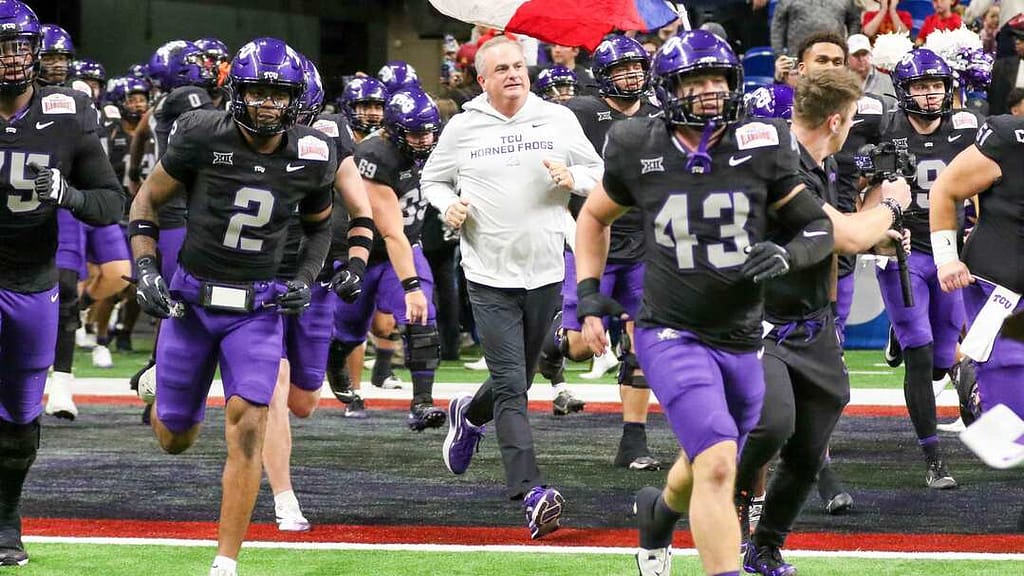
If I had to explain TCU in one sentence, I would say this: the Horned Frogs win attention by creating discomfort. Their best teams do not simply outlast opponents; they unsettle them. The pace is demanding, the spacing is stressful, and the overall mentality is rooted in pressure rather than patience.
That identity has shown up in several consistent ways:
- A preference for speed over sheer bulk
- An offense designed to create explosive plays
- A defense willing to take calculated risks for momentum-changing moments
Those traits matter because they give TCU clarity. In college football, clarity is often as valuable as talent. Programs that know exactly how they want to play can recruit more efficiently, develop players more intentionally, and manage game situations with greater conviction. TCU has long understood that it cannot afford to be vague.
The Legacy Of Explosive Football
The national audience got an unmistakable reminder of TCU’s ceiling during the 2022 season, when the Horned Frogs surged into the College Football Playoff and then beat Michigan in a semifinal that felt like a declaration. That game was more than an upset. It was proof that TCU’s formula, when fully realized, could stretch even a heavyweight opponent beyond its comfort zone.
The subsequent loss in the national championship did not erase what came before it. In some ways, it clarified the program’s position even more. TCU showed how far speed, confidence, offensive boldness, and opportunistic defense could carry a team. It also exposed the fine margins that separate a legitimate contender from a champion built to survive every physical test at the highest level.
For me, that season still defines the modern TCU conversation. It captured the program’s appeal and its challenge in the same frame. TCU can absolutely rise high enough to disrupt the national order. The harder question is whether it can sustain that level often enough to make disruption feel normal.
How TCU Competes In Texas
No football program in Texas operates in isolation. Every school is judged not only on its own results but also against the state’s larger ecosystem of power, money, recruiting pull, and visibility. That is what makes TCU’s place so fascinating. It competes in a neighborhood filled with programs that have larger fan bases, louder historical megaphones, and, in many cases, deeper reservoirs of natural attention.
And yet TCU keeps finding oxygen.
Part of that comes from style. In a crowded market, style is not cosmetic; it is strategic. A team that plays fast and aggressively is easier to remember, easier to market, and easier for recruits to imagine themselves joining. TCU’s football identity gives it a strong sales pitch in living rooms across Texas. It can tell prospects, with credibility, that they will not disappear into a bland system. They will be part of something vivid.
Another part comes from developmental culture. TCU has often succeeded by finding players who may have been overlooked, under-projected, or imperfectly evaluated elsewhere and then fitting them into a system that magnifies what they do best. That does not mean the program ignores star talent. It means the coaching environment has frequently been structured to maximize growth rather than merely collect names.
The comparison below helps explain how the program’s football personality has typically distinguished it in-state:
| Area | TCU’s Traditional Edge | Why It Matters |
|---|---|---|
| Offensive Philosophy | Tempo, spacing, explosive intent | Forces defenses into stress and creates momentum quickly |
| Defensive Style | Aggression and turnover hunting | Generates short fields and emotional swings |
| Recruiting Approach | Fit, speed, and development | Helps TCU compete even without the broadest reach |
| Program Identity | Underdog confidence with major ambition | Gives the team a distinct voice in a crowded market |
The Strategic Trade-Offs Behind The Style
Every football identity comes with a bill, and TCU’s is no exception. Teams that lean on speed and aggression can become vulnerable when execution slips. A defense built to create havoc may also give up chunk plays. An offense chasing explosives can drift into inconsistency if rhythm disappears. Momentum, once lost, can leave an aggressive team looking exposed rather than fearless.
This is the structural tension inside TCU football. The very qualities that make it dangerous can also make it volatile.
I do not see that as a weakness in the simplistic sense. I see it as the price of ambition. TCU does not usually build itself to win ugly every week by shrinking games and waiting for opponents to make mistakes. It often tries to impose itself. That approach can produce unforgettable highs, but it also demands precision and emotional steadiness. When those are present, TCU looks dynamic. When they are absent, the same system can feel fragile.
The real test for the program, then, is not whether it should abandon its identity. It is whether it can refine that identity so that aggression becomes more sustainable across a full season.
Coaching, Culture, And The Value Of Conviction
The programs I trust most are the ones that know how they want to sound, even when the volume changes. TCU has repeatedly shown that its institutional football voice is recognizable. Coaches may shift tactics, staffs may change, and rosters may evolve, but the Horned Frogs tend to remain identifiable.
That matters more than people admit. College football now moves at a punishing speed. The transfer portal reshapes rosters quickly. Player expectations are more immediate. Public judgment is constant. In that environment, cultural drift can be fatal. Programs that lose their internal logic begin to look reactive, and reactive teams rarely develop lasting authority.
TCU’s better periods have been defined by conviction. The program plays as though it believes it belongs in big moments. That mentality is not empty branding; it is operational. It affects recruiting pitches, practice tempo, game management, and the emotional posture of the roster. Players are more likely to perform boldly when the institution around them behaves boldly.
What TCU Must Protect Going Forward
The modern challenge is not simply reaching relevance. It is defending relevance year after year while the sport’s economics and politics keep changing. For TCU, that means protecting the qualities that made it nationally credible in the first place.
First, it must continue to recruit with discipline rather than imitation. Programs get in trouble when they chase the image of a rival instead of deepening their own advantage. TCU’s path has never been to become a replica of the state’s biggest brands. Its path is to remain unmistakably TCU.
Second, it must keep developing difference-makers rather than depending exclusively on ready-made stars. The portal can supplement a roster, but the strongest programs still create internal growth. TCU’s football identity has always looked healthiest when coaching and player development are tightly aligned.
Third, it must preserve the emotional edge that has made the program so watchable. TCU is most compelling when it plays with urgency, not caution. In a sport increasingly shaped by corporate language and transactional movement, there is real competitive value in a team that still looks hungry.
Why TCU Matters Right Now
TCU matters because it represents a version of college football that still feels alive with invention. It is a reminder that relevance is not reserved for the loudest brands, and that ambition paired with a clear tactical identity can still bend the sport’s usual order.
I see the Horned Frogs as more than a Texas team trying to hold ground. I see a program that keeps forcing the broader sport to take a harder look at what matters most. Not just money. Not just history. Not just size. But identity, clarity, and the willingness to play without fear. Right now, when college football is busy deciding what it wants to become, that lesson feels more valuable than ever.