
The Texas Longhorns are entering one of the most significant periods in program history as the team continues adapting from a successful Big 12 era into a new identity as an SEC contender. The move was more than a conference change. It represented a strategic shift in recruiting, scheduling, competition level, and expectations for one of college football’s most recognizable programs.
Texas arrived in the SEC after years of rebuilding under head coach Steve Sarkisian, culminating in a return to national prominence with a Big 12 Championship in 2023 and a College Football Playoff appearance during the 2023 season. The transition has forced the Longhorns to redefine what success looks like while competing against programs with decades of championship experience in the conference.
The 2026 season represents another important chapter. With players such as quarterback Arch Manning leading the offense and a roster built around SEC-level talent, Texas is no longer viewed as a program searching for relevance. The focus has shifted toward establishing itself among the conference’s elite.
Texas’ Final Big 12 Chapter Created Momentum For The SEC Era
Before entering the SEC, Texas needed to restore confidence within its own program. The Longhorns experienced several inconsistent seasons following their last national championship appearance in 2009, cycling through coaching changes and struggling to maintain national relevance.
Steve Sarkisian’s arrival in 2021 began a structural rebuild focused on player development, recruiting, and offensive identity. The breakthrough came during the 2023 season when Texas finished 12-2, defeated Oklahoma in the Red River Rivalry, won the Big 12 Championship against Oklahoma State, and earned a spot in the College Football Playoff.
That season became a turning point because Texas proved it could compete at the highest level before entering the SEC.
According to Texas football history, the Longhorns have built one of the most successful traditions in college football, including four recognized national championships and more than 900 program victories. The challenge after leaving the Big 12 was maintaining that historical standard against an even deeper conference.
| Season | Achievement | Impact |
|---|---|---|
| 2023 | Big 12 Championship | Confirmed Texas’ national resurgence |
| 2023 | College Football Playoff appearance | Increased national expectations |
| 2024 | First SEC season | Beginning of new competitive era |
| 2026 | SEC contender phase | Opportunity to establish long-term identity |
The move into the SEC allowed Texas to align itself with the level of competition it wanted to consistently face, but it also created a new standard where every weakness would be exposed.
The SEC Has Changed Texas’ Approach To Building A Roster
The biggest difference between the Big 12 and SEC eras has been roster construction. Texas is no longer building primarily for conference competition. The program is preparing for a schedule where physical depth, defensive speed, and offensive versatility determine success.
The SEC has consistently produced some of college football’s most talented defensive units. Programs such as Georgia, Alabama, LSU, and Tennessee regularly send players to the NFL, forcing teams to recruit and develop talent capable of competing against professional-level athletes.
Texas responded by increasing its emphasis on elite recruiting classes, transfer portal additions, and position-specific development.
The SEC football landscape has historically been shaped by dominant defensive play and strong line-of-scrimmage performance. For Texas, adapting means creating a roster capable of surviving a demanding schedule rather than relying only on individual star power.
The Longhorns’ recruiting strategy under Sarkisian has focused heavily on maintaining depth across every position group. Quarterback talent receives national attention because of Arch Manning, but championship-level teams require strong offensive lines, defensive fronts, and experienced players across the roster.
Steve Sarkisian’s Offensive Identity Has Become Central To Texas’ Future
One of the defining elements of Texas’ transformation has been the development of an offensive identity under Steve Sarkisian.
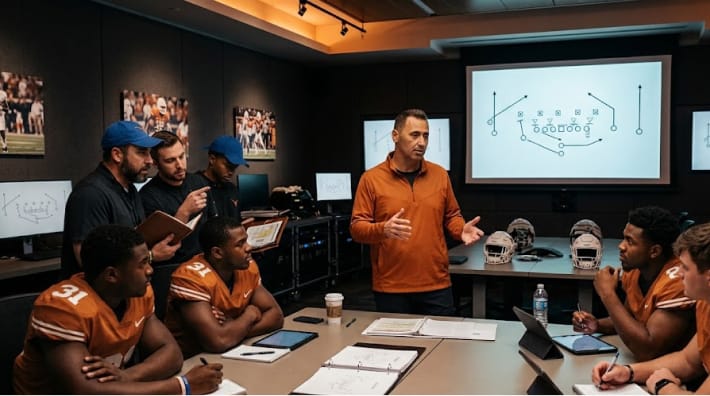
Sarkisian arrived in Austin with a reputation as one of college football’s strongest offensive minds after previous coaching stops at Alabama, Washington, and USC. His system emphasizes quarterback decision-making, spacing, defensive recognition, and explosive plays.
The success of Quinn Ewers during the 2023 and 2024 seasons helped establish the foundation, but the arrival of Arch Manning represents the next stage of that offensive evolution.
Texas has positioned the quarterback position as the centerpiece of its SEC ambitions. The program understands that elite quarterbacks often determine whether teams compete for conference championships or remain middle-tier programs.
Manning’s development will receive significant attention, but the larger story is how Texas has built an offensive structure capable of supporting high-level quarterback play.
The Longhorns are attempting to create consistency rather than depending on individual seasons of exceptional talent.
Recruiting Battles Have Become More Important In The SEC Era
The SEC transition has changed how Texas approaches recruiting. Competing for conference championships requires winning recruiting battles against programs with national championship histories and established pipelines.
Texas has benefited from its location, brand recognition, facilities, and NIL opportunities, but the competition has become significantly stronger.
The Longhorns now compete directly with programs such as Georgia, Alabama, LSU, and Texas A&M for many of the same elite prospects. Winning those battles has become essential for maintaining long-term success.
Recent recruiting classes have reflected Texas’ commitment to building around premium positions, including offensive line, defensive line, and secondary talent.
| Recruiting Priority | Importance For SEC Competition |
|---|---|
| Offensive Line | Protects quarterbacks against elite pass rushers |
| Defensive Line | Controls physical matchups |
| Secondary | Handles explosive SEC passing attacks |
| Quarterback | Determines offensive ceiling |
The program’s recruiting approach shows a broader change in identity. Texas is no longer trying to rebuild. It is trying to maintain championship-level depth.
The Texas-Oklahoma Rivalry Has Gained A New National Stage
The move to the SEC also changed one of college football’s most historic rivalries. The Texas-Oklahoma rivalry, known as the Red River Rivalry, moved from the Big 12 schedule into the SEC environment.
The annual matchup at the Cotton Bowl in Dallas remains one of the most unique traditions in college football, splitting the stadium between burnt orange and crimson.
Texas’ ability to compete nationally depends partly on maintaining dominance in traditional rivalries while creating new conference rivalries.
The SEC schedule provides more opportunities for high-profile games, but it also reduces the margin for error. A single loss can dramatically impact conference championship hopes and playoff positioning.
For Texas fans, this creates a different football experience. Every major matchup carries increased national importance.
Fan Culture And Program Expectations Are Entering A New Era
Texas football has always carried enormous expectations because of its history, resources, and fan base. The SEC era has intensified those expectations.
The program’s supporters are not simply looking for winning seasons. They expect conference championships, playoff appearances, and national title contention.
This cultural shift is important because successful programs require alignment between players, coaches, administration, and fans.
The Longhorns are attempting to create a modern SEC program while maintaining traditions that have existed for more than a century.
The iconic burnt orange identity remains unchanged, but the competitive environment surrounding it has transformed.
Texas’ Long-Term Goal Is Becoming An SEC Powerhouse
The transition from Big 12 champion to SEC contender is not measured by one season. It is measured by sustained competitiveness.

Programs like Alabama and Georgia have established standards that require elite recruiting, player development, and consistent execution. Texas is attempting to reach that same level.
The foundation has already been built. The Longhorns have a proven coaching staff, national recruiting appeal, quarterback talent, and one of college football’s strongest brands.
The next step is proving that success can continue against the deepest conference schedule in the sport.
The 2026 season will provide another measurement point for Texas. With Arch Manning leading the offense, an SEC-tested roster, and championship expectations surrounding the program, the Longhorns are entering a period where their new identity will be defined.
Texas is no longer trying to return to relevance. The program is attempting to establish itself as one of the SEC’s permanent contenders.