Every great defensive strategy starts with a solid coverage shell. It’s like a blueprint for creating chaos. It mixes strategy with the rawness of a street fight, turning a coach’s ideas into a team effort.
Pete Kwiatkowski, Texas’s defensive coordinator, sees it as more than just calling plays. He orchestrates a symphony of strategic ambiguity. His approach, influenced by Justin Wilcox, focuses on MOFO schemes. These leave the middle of the field open, like a tempting but dangerous path.
In 2024, his team mostly used Cover 3 (39.7% of snaps) and Cover 4 (25.7%). Together, they used these two shells for 65% of the game. This dedication to just two strategies might make some defensive fans blush.
But there’s a twist. Kwiatkowski brought in co-DC Johnny Nansen, an expert in MOFC schemes. This mix of philosophies could be the key to success. In a world where offenses are getting more complex, mastering two strategies might be the ultimate defensive advantage. Let’s see how it plays out.
Pressure packages
The most dangerous pressure isn’t the one you see coming; it’s the one that materializes from thin air while your eyes are focused elsewhere. This is the core philosophy behind Texas’s defensive approach under coordinator Pete Kwiatkowski. Forget the barroom brawl mentality – this is cerebral warfare played out on grass.
Kwiatkowski’s system operates on a simple but brilliant premise: why sacrifice coverage bodies when you can create chaos with the four you already have? The answer lies in what analysts call “simulated pressure.” It’s football’s version of a magic trick – making the offense believe six are coming when only four actually rush.
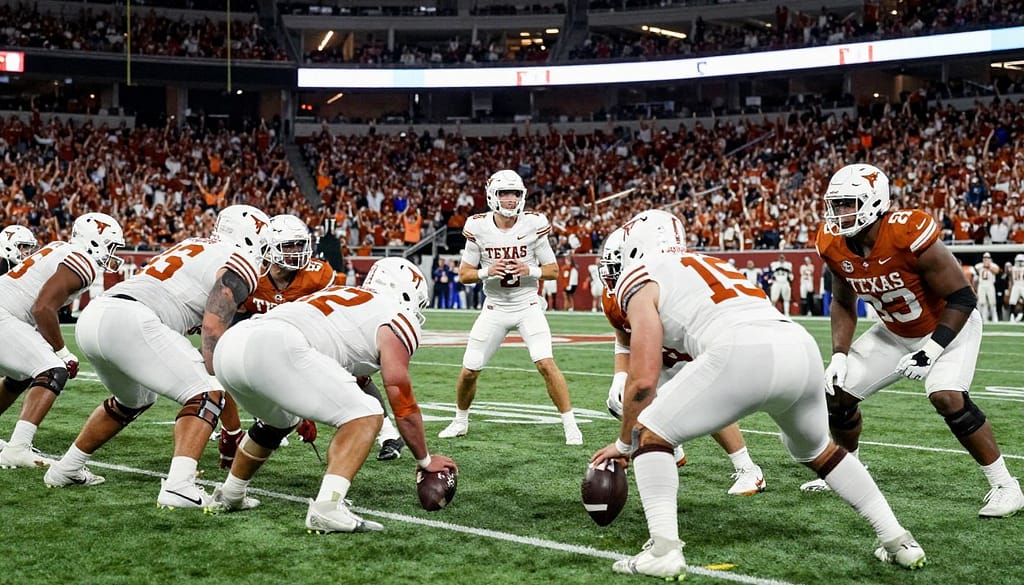
How does this illusion work? Through meticulously choreographed defensive line games. We’re talking twists, stunts, and loops that would make a Swiss watchmaker nod in approval. The defensive tackles might crash inside while the ends loop around them. Or a tackle might engage then suddenly slip outside as his teammate shoots the gap he just vacated.
These movements serve two purposes. First, they physically defeat blocks through misdirection. Second, and more importantly, they short-circuit an offensive line’s communication. When guards and tackles can’t identify who they’re blocking from one second to the next, protection schemes collapse from confusion alone.
The signature move in this Texas defense tactics playbook? What I call the “bait-and-switch blitz.” Here’s how it unfolds:
- A terrifying edge rusher shows blitz, causing the tackle to brace for impact
- At the snap, that rusher drops into a short zone coverage instead
- Meanwhile, a safety who was aligned deep suddenly comes screaming downhill
- The quarterback sees four rushers but can’t find his hot receiver – because that’s exactly who the dropped edge is now covering
This approach creates what defensive coaches dream about: pressure with coverage integrity. The offense faces a nightmare scenario – they’ve accounted for the blitzing safety, but now they’re missing a check-down option. It’s like playing chess against someone who keeps introducing new pieces.
To understand why this system is so effective, let’s compare it to traditional pressure approaches:
| Tactic | Traditional Blitz Packages | Texas Simulated Pressure | Psychological Impact |
|---|---|---|---|
| Personnel Commitment | 5-6 rushers minimum | 4 rushers (but looks like 5-6) | Forces offense to guess wrong |
| Coverage Sacrifice | Man-to-man, vulnerable zones | Full zone coverage maintained | Quarterback sees covered receivers |
| Timing | Predictable down/distance | Any down, any distance | Creates constant uncertainty |
| Communication Strain | On blitzing defenders | On offensive line/quarterback | Causes protection breakdowns |
This table reveals the genius of the system. While traditional blitzes are obvious commitments, Texas’s pressure exists in the quarterback’s mind long before the snap. The mere possibility of simulated pressure affects play calling, protection slides, and quarterback reads from the moment the offense breaks the huddle.
The beauty of this approach becomes clear when you examine its foundation in the 4-2-5 defensive scheme. That fifth defensive back isn’t just extra coverage – he’s a pressure wildcard who can blitz from depth without telegraphing the move. The alignment naturally lends itself to these deception games.
What’s the result? Quarterbacks facing Texas must process two conflicting realities simultaneously. They see four down linemen but must account for six potential rushers. They identify a safety in deep alignment but must remember he could be coming in 1.5 seconds. This cognitive load leads to hesitation, and in football, hesitation is the father of sacks and the mother of interceptions.
Kwiatkowski’s pressure packages prove a fundamental truth about modern defense: sometimes the most effective aggression is the kind you never actually commit. By mastering the art of simulated pressure, Texas creates havoc without sacrificing numbers. It’s resource allocation raised to an art form – getting seven men’s worth of pressure from just four.
The psychological dimension can’t be overstated. When an offense spends a week preparing for these Texas defense tactics, they’re not just practicing blocks and reads. They’re trying to solve a moving puzzle that changes its shape every play. That mental exhaustion might be the system’s greatest achievement of all.
Quarterback containment
College football’s most chaotic element, the scrambling quarterback, is tamed by discipline. Texas stands strong against mobile threats. But, the truth is in the details. Sack-adjusted metrics show quarterbacks still get 4-5 yards per carry. This isn’t a complete stop; it’s managed containment.
Imagine a matador in a bullring. The sideline is the cape. Texas cornerbacks use their discipline to keep quarterbacks in check. They guide them back to the center, where the real challenge lies.
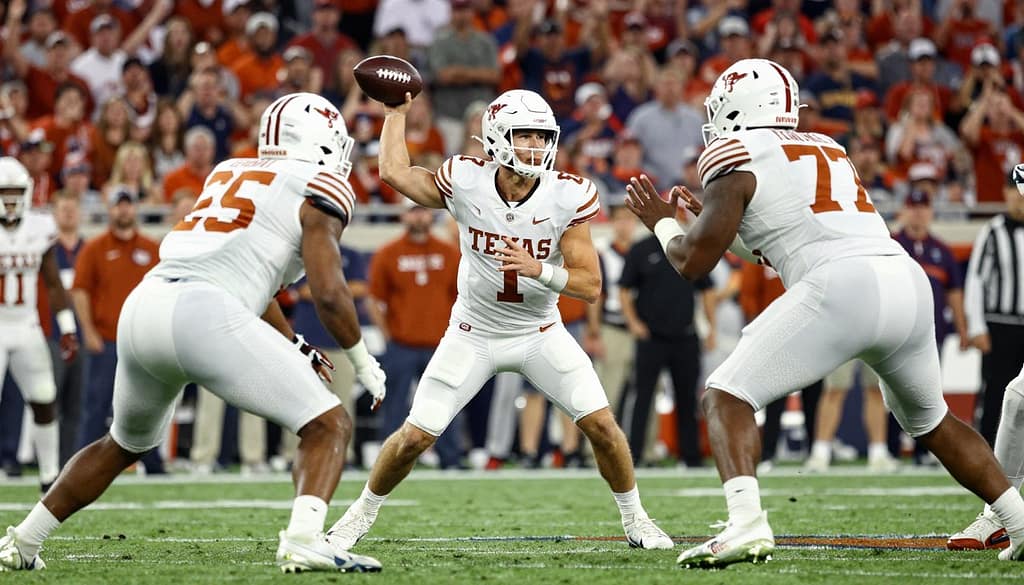
Anthony Hill is more than a linebacker. He’s a fast, powerful force. His speed turns a positive scramble into a loss. This mix of discipline and power is key to their Texas defense tactics.
The NCAA’s sack stats can be misleading. Remove those, and you see a different story. This approach is smart. It aims to make yards hard to get, not to stop them all.
This strategy was tested against players like Marcel Reed. The focus is on smart play, not just heroics. It’s a team effort. Every defender knows their role in stopping the quarterback. This makes the Texas pass defense very effective.
| Containment Factor | Surface Stat | Sack-Adjusted Reality | Defensive Impact |
|---|---|---|---|
| QB Rush Yards | Minimal (Top 10 Rank) | 4-5 yards per carry | Controlled efficiency, not elimination |
| Cornerback Discipline | Pass Breakups | Sideline Funnel Rate | Forces QBs back inside to pressure |
| Linebacker Closing Speed | Tackles For Loss | Scramble Containment Success % | Negates extended plays quickly |
| Team Speed | 40-Yard Dash Averages | Angle Pursuit Efficiency | Collective pursuit negates escape lanes |
The table shows the real story. Texas doesn’t stop mobile quarterbacks; they manage them. They turn big plays into small gains. This needs great athleticism and coaching. As shown in the film breakdown, the team works together perfectly.
Can this approach work against the best escape artists? That’s the big question. The current method relies on team speed and perfect execution. One mistake, and the whole plan falls apart. But for now, their Texas defense tactics against scramblers are a masterclass in control.
Vulnerabilities
Every empire has a flaw. For this defensive powerhouse, the weakness is in its playbook. Cover 3 and Cover 4 schemes can be countered by stretching the field and attacking the seams.
The answer lies in Texas’s freakish athletic talent. This talent turns theory into a highlight-reel tackle. But, what happens when theory meets a brutal test? Arizona State presents that exam, even without top target Jordyn Tyson.
Recent analysis of the Longhorns’ performance shows technical cracks. Misalignments, missed edge containment, and gaps in integrity appear in key moments. These Texas defense tactics can be exposed on third down, in the red zone, or during overtime.
A team’s resilience is tested in crunch time. Metrics like fourth-quarter comeback ability on the road and red-zone from last season show where a unit bends or breaks. A fast-paced attack, like Mississippi State’s, is designed to find and exploit these pressure points.
Is this a fatal flaw or a challenge for a roster full of future NFL talent? The best Texas defense tactics might be the raw, unteachable instinct of its players. The season will show if brilliant individuals can consistently cover up a schematic bullseye. We’re about to find out.