
The NFL sells competition, but what keeps a franchise emotionally durable is culture. In Houston, that culture has become increasingly visible because the Texans are no longer just asking fans to show up they are asking them to participate, to signal belonging, and to help define what game day feels like in a city still refining its football identity.
What strikes me about the Texans right now is that their fan experience is built less on nostalgia than on activation. This is not one of the league’s century-old brands with inherited rituals that simply repeat themselves. Houston has had to build its traditions in public, and that process has made the relationship between team and crowd feel unusually direct.
A Franchise Still Building Its Rituals
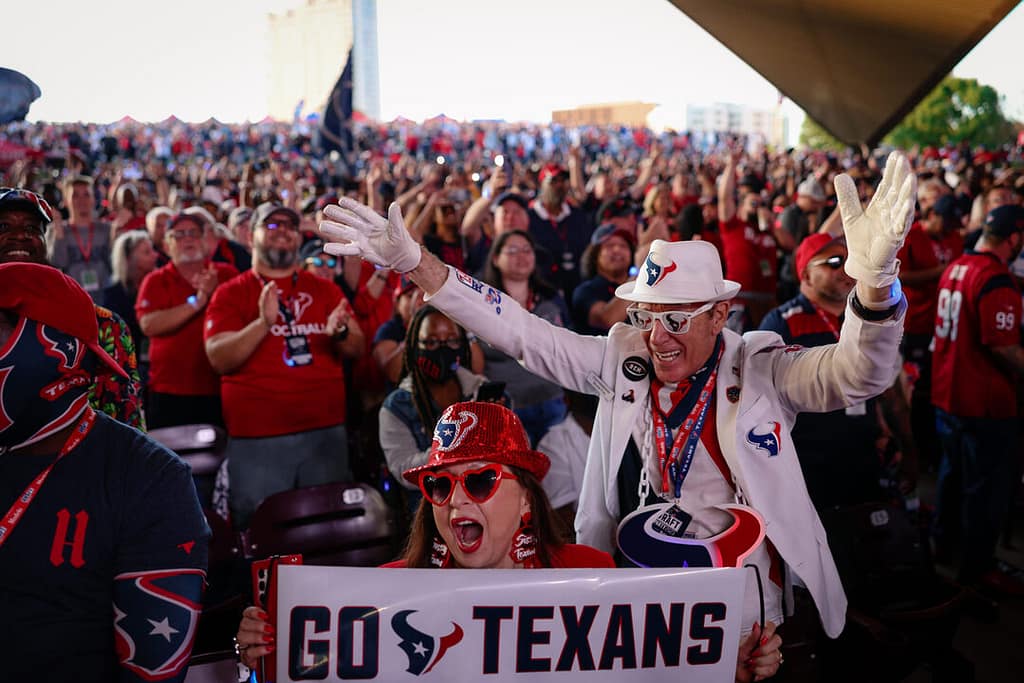
Every team says it values its supporters, but the Texans have leaned into something more specific: codifying fan behavior as part of the product. On the club’s own game-day pages, the ritual sequence is explicit arrive in time for team introductions, join the Texans SWARM chant, and throw the “H” up. That matters because it turns fandom from passive consumption into choreography. The game is still the main event, but the crowd is given a role, not just a seat.
That structure helps explain why Houston Texans fan engagement has become a meaningful topic rather than a marketing slogan. Houston is a large, diverse, fast-moving city, and sports allegiances are often layered across generations, colleges, neighborhoods, and other pro teams. In that environment, the Texans have to do more than win attention on Sundays. They have to manufacture recognizable civic rituals that feel native to the city.
The most effective traditions usually do two things at once: they simplify participation and deepen emotional meaning. The Texans have been unusually disciplined about both. A hand sign is easy to copy. A chant is easy to learn. A color-coordinated game day is easy to join. But once those gestures recur often enough, they stop feeling promotional and start feeling communal. That is the threshold every franchise wants to cross.
Why Battle Red Day Works
No Texans tradition captures that transformation better than Battle Red Day. The custom traces back to the team’s first red-jersey appearance in a 2003 win over Carolina, and over time it evolved from a uniform wrinkle into one of the franchise’s most anticipated identity markers. The power of Battle Red is not merely aesthetic. It creates an instant visual referendum on fan buy-in, turning the stadium into an active display of allegiance rather than a mixed field of casual attendance.
I think Battle Red works because it gives Houston something emotionally legible. Teams often talk about “home-field advantage” as if it is produced by noise alone, but color can be just as powerful as sound. A stadium awash in red tells players, broadcasters, and opponents that the audience has chosen not just to attend, but to identify. In a league where televised atmosphere shapes perception as much as performance, that consistency matters.
It also helps that Battle Red carries narrative memory. The best traditions are not random; they are sticky because they connect the present to an origin story. Houston’s red-game identity began with a notable victory and has been preserved as a special occasion rather than diluted into an every-week costume. That scarcity gives it force. Fans are not simply wearing team colors. They are stepping into a ritual with a backstory, and backstory is what turns merchandise into symbolism.
The SWARM Chant And The “H” Up As Civic Language
The Texans’ most interesting fan customs may be the ones that function as shared language. The SWARM chant is intentionally collective, a vocal cue designed to bind strangers into a temporary unit. The “H” up gesture works differently but just as effectively: it is visual shorthand for local identity, linking the team to the broader Houston habit of foregrounding “H-Town” as more than a nickname.
That matters because sports traditions are strongest when they can travel beyond the stadium. A chant can appear in tailgates, watch parties, social posts, and playoff sendoffs. A hand sign can migrate into everyday civic performance. The Texans have benefited from that portability. Their traditions are not locked inside NRG Stadium; they are designed to circulate, and circulation is how modern fandom scales.
From a brand perspective, these are smart rituals because they are native to participation rather than dependent on expensive access. Fans do not need a premium seat to join a chant. They do not need insider knowledge to raise an “H.” In a sports economy increasingly segmented by price and exclusivity, the Texans’ most visible traditions remain accessible. That accessibility is one of the clearest signs of healthy fan engagement.
When Engagement Becomes Feedback
Where the Texans move beyond many franchises is in treating fan culture as a source of organizational input, not just atmosphere. The team’s Fan Council was launched as a formal channel for supporter feedback and has since been framed as a place where dozens of fans can help inform decisions that affect both the organization and the game-day experience. In 2025, the club said the Fan Council included nearly 60 fans and highlighted its role in shaping parts of the broader experience.
That is important for two reasons. First, it gives the club a mechanism for listening that goes beyond social media sentiment, which is often loud but unrepresentative. Second, it reinforces the idea that fandom is not only expressive but consultative. The message is subtle but powerful: supporters are not just there to be entertained; they are part of the design loop.
I would argue that this is where the Texans’ engagement strategy becomes more sophisticated than simple pageantry. Chants, colors, and hand signs create atmosphere, but feedback structures create legitimacy. They tell fans that the organization sees them not as a market segment to be activated and then measured, but as a constituency whose experience is worth refining. That can be harder to build than a game-day slogan, but it tends to last longer.
Sound, Spectacle, And The Making Of Home Field
There is also an overlooked performance layer to all of this. The Texans have used elements like Deep Steel Thunder, the team’s percussion presence, to intensify the sensory environment around games. These are not trivial add-ons. In-stadium identity is built through repetition, tempo, and anticipation as much as through scorelines. Fans remember the feeling of arrival, buildup, and release, and teams that manage those moments well create stronger emotional retention.
That is especially relevant in Houston, where pro sports attention is competitive and public energy can be pulled in several directions at once. The Texans need the stadium to feel distinctive, immediate, and unmistakably theirs. Rituals do that work. They turn abstract loyalty into visible behavior, and visible behavior is what makes a home venue feel like a site of belonging rather than just an event space.
The result is a fan culture that may still be younger than those of the NFL’s legacy powers, but not necessarily thinner. In some ways, newer traditions can be more legible because they are deliberately built for a modern audience. They are camera-ready, socially portable, easy to teach, and emotionally direct. That does not make them artificial. It makes them contemporary.
Why This Matters Now
This matters now because the Texans are operating in the most consequential phase of any franchise’s cultural life: the point where relevance on the field can either harden into long-term identity or fade back into episodic excitement. Winning helps, of course, but sustained fan attachment requires more than a promising roster or a good season. It requires rituals that let people see themselves inside the team story.
What I see in Houston is a franchise trying to do exactly that. Battle Red Day gives the crowd a shared uniform. The SWARM chant gives it a shared voice. The “H” up gesture gives it a local symbol. The Fan Council gives it a measure of influence. Taken together, those traditions reveal something larger than entertainment strategy: they show how a football team can become a civic habit. And in a league where attention is constant but loyalty is earned, that may be the most important victory a franchise can claim.