The Dallas Cowboys have reached the point where promise is no longer enough. With a roster built to compete immediately and little patience for a slow reset, this draft feels less like a routine personnel exercise and more like a defining test of how serious Dallas is about chasing a championship right now.
I see this moment as especially important because Dallas no longer needs to discover its identity. The offense already gives the team a credible foundation. What matters now is whether the front office can use this draft to correct the weaknesses that kept a talented roster from looking complete.
Why Dallas Enters The Draft Under Pressure
The Cowboys are operating in a familiar but increasingly urgent space: good enough to contend, but not complete enough to feel secure. That tension is shaping the way I view this draft. Dallas does not need a total reset or a dramatic philosophical shift. It needs precision, and it needs impact.
This is what makes the current Dallas Cowboys NFL Draft cycle so consequential. The team has the kind of offensive core that should keep it competitive, but a win-now roster cannot afford obvious vulnerabilities on defense. For Dallas, the draft is not simply about adding talent. It is about aligning the roster with the narrow demands of a championship window.
The area that stands out most clearly is the secondary. Cornerback and safety are not abstract needs; they are the positions most likely to determine whether this team can hold up against elite passing attacks. In today’s NFL, that matters every week, but it becomes especially unforgiving in January.
The Secondary Has Become The Clear Priority
If there is one theme that defines Dallas entering the draft, it is the need for defensive backfield help. I do not see this as a cosmetic adjustment. I see it as structural repair. The Cowboys need more reliability in coverage, more flexibility in personnel packages, and more confidence on the back end.
That matters because defensive weakness travels. A team can survive depth issues at certain spots. It cannot comfortably survive recurring breakdowns in coverage when expectations are high. Dallas appears to understand that reality, which is why cornerbacks and safeties have become the natural focus of its draft outlook.
A stronger secondary would do more than patch a problem. It would expand the defense as a whole. Better coverage can give the pass rush more time to work, allow the coaching staff to be more aggressive, and reduce the pressure on the offense to carry games into shootout territory. For a contender trying to preserve its offensive edge, that kind of defensive support is not optional. It is foundational.
How Dallas’ Draft Priorities Stack Up
The Cowboys’ overall approach becomes easier to understand when the major needs are laid out side by side.
| Area | Why It Matters | Likely Draft Value |
|---|---|---|
| Cornerback | Improves coverage stability and matchup flexibility | High |
| Safety | Strengthens communication, range, and back-end support | High |
| Running Back Depth | Adds competition and insurance without major investment | Moderate |
| Trade Flexibility | Allows Dallas to pursue impact talent aggressively | High |
This is why the draft board may tilt heavily toward defensive backs early. Dallas is not just trying to add bodies. It is trying to add players capable of changing the texture of the defense.
A Trade-Up Move Would Match The Moment
The possibility of an aggressive move up the board makes sense to me because Dallas is no longer drafting from a long-term rebuilding perspective. Passive draft strategies often suit teams with multiple timelines and widespread roster holes. The Cowboys are in a different place. Their mandate is more immediate: identify impact talent and secure it if the price is reasonable.
That is why trade-up talk feels plausible rather than theatrical. If Dallas believes there is a cornerback or safety who can meaningfully transform the defense, moving up would reflect the urgency of a team that understands where its opportunity lies. In win-now mode, hesitation can be as costly as a mistake.
There is risk, of course. Trading up reduces flexibility later in the draft and raises the pressure on the pick to contribute quickly. But Dallas is already operating under pressure. In some ways, the larger mistake would be treating this as a standard draft when the roster itself suggests otherwise.
The EJ Smith Evaluation Reveals Something Important
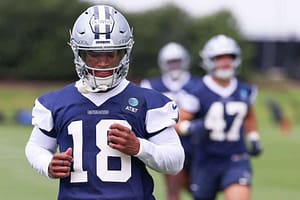
One of the quieter but more revealing parts of Dallas’ draft preparation is its interest in younger depth options such as EJ Smith. On the surface, that can look like a secondary storyline beside the far bigger need in the defensive backfield. I think it actually reveals disciplined roster thinking.
Contending teams do not build themselves on star power alone. They also improve by finding practical, affordable depth at supporting positions. A player like Smith makes sense in that framework. He gives Dallas a chance to add backfield competition without diverting premium resources away from defense.
What stands out here is the balance of the strategy. The Cowboys are not just searching for splash. They appear to be trying to build a more complete roster, one that can absorb injuries and maintain function over the course of a long season.
The logic behind that approach is straightforward:
- Dallas can use premium draft capital on the secondary while still addressing running back depth economically.
- Adding a young depth back helps support the offense without forcing the team to neglect its defensive priorities.
- Smart late-round or low-cost additions often matter more for contenders than headline-grabbing luxury picks.
That is the kind of detail that separates a top-heavy team from a more durable one.
Why The Offense Allows Dallas To Be Focused
What makes this strategy especially compelling is that the Cowboys do not appear to need a dramatic overhaul on offense. The unit already has enough proven ability to keep the team competitive. That gives the front office the freedom to focus more directly on roster balance rather than chasing unnecessary flash.
I see that as a sign of maturity, at least in theory. Teams often misuse the draft by adding strength where they are already comfortable while leaving more urgent problems unresolved. Dallas has an opportunity to do the opposite. It can use this draft to reinforce its weakest area while trusting the offense to remain the team’s engine.
That may be the smartest path available: strengthen the defense, add selective depth, and resist the temptation to confuse excitement with progress.
Why This Matters Right Now
The Cowboys are not entering this draft with the patience of a rebuilding team or the freedom of a franchise playing for the future. They are entering it with urgency, expectations, and a roster that demands sharp decision-making. That is why this moment feels so significant.
If Dallas identifies the right defensive back and is willing to act decisively, the team could come out of this draft looking more balanced, more adaptable, and more credible as a contender. If it fails to address the secondary with enough conviction, the same weaknesses that limited the roster before could define it again.
I view this draft as a real test of self-awareness. The Cowboys already know their offense can keep them relevant. What they do now will show whether they understand what is still missing. In a win-now season, that is not a small question waiting for another year. It is the question, and the answer may shape everything that follows.