The Dallas Cowboys 2026 schedule is already creating pressure before Dallas plays a meaningful snap, and that is exactly why this slate deserves more than a quick schedule-release reaction. Between the Week 3 international game in Brazil, the usual national attention, and the challenge of managing rhythm early in the season, the Cowboys are walking into a calendar that can shape perception before the team has time to settle.
For Dallas, the schedule is never just a list of opponents. It is a national television product, a travel test, a fan expectation machine, and a pressure gauge for a franchise that is rarely allowed to develop quietly. I see this year’s schedule as one of those cases where the calendar itself becomes part of the story.
Why The Dallas Cowboys 2026 Schedule Feels Heavy Early
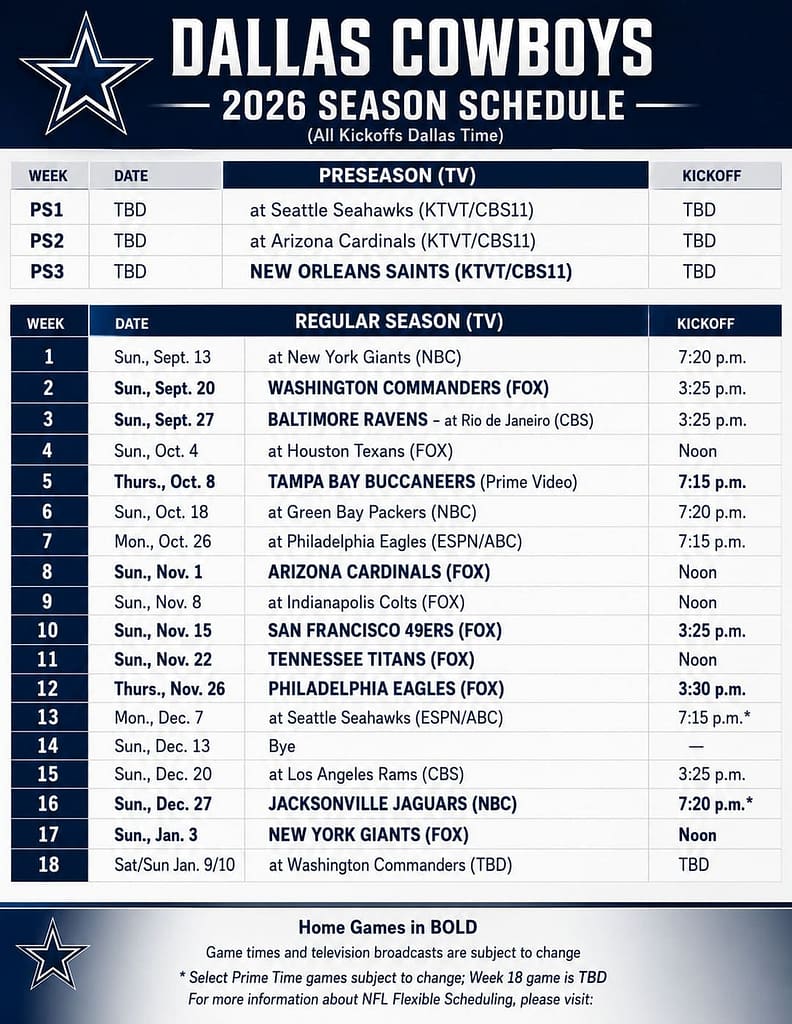
The first pressure point is obvious: Dallas has to handle major attention almost immediately. The Dallas Cowboys 2026 schedule includes a Week 3 matchup against the Baltimore Ravens in Rio de Janeiro, putting the Cowboys inside one of the league’s most visible international windows.
That is exciting for the brand. It is also difficult football logistics.
International games disrupt routine. The week feels different. Travel planning changes. Recovery becomes more complicated. Media obligations expand. Even for a franchise used to constant attention, Brazil is not just another road trip.
That makes the Cowboys’ opening stretch feel like an early-season pressure test. Dallas will not have the luxury of easing into the year. The team has to manage performance, travel, preparation, and perception all at once.
Brazil Turns A Schedule Note Into A Brand Event
The Brazil game is the part of the schedule that changes the tone. The Cowboys are not simply playing away from home; they are stepping into an international showcase at Maracanã Stadium against Baltimore. The NFL Rio Game announcement gives the matchup a bigger commercial and cultural frame than a normal Week 3 game.
That matters because Dallas is one of the few NFL teams built for this kind of stage. The Cowboys’ brand travels. Their fan base travels. Their games draw casual attention even when the football conversation is messy. The league knows that, which is why Dallas makes sense for an international platform.
But the advantage cuts both ways. A global spotlight can strengthen a team’s image if it performs well. It can also amplify problems if Dallas looks unprepared. Against a physical, high-profile opponent like Baltimore, the Cowboys will not be judged only on the final score. They will be judged on how ready they look.
That is the burden of being the Cowboys. Exposure is never neutral.
The Hidden Issue Is Rhythm, Not Just Travel
The easy angle is to say the Cowboys have a tough travel schedule. The sharper angle is rhythm. NFL teams are creatures of routine, especially early in the season when timing, communication, and conditioning are still stabilizing.
An international game forces a team to manage more than miles. Practice schedules may need adjustment. Sleep cycles become part of preparation. Coaching staffs have to decide how much to modify the week without making the event feel too unusual. Players have to treat a global showcase like a normal business trip, even when nothing about it feels normal.
That creates an international travel variable that can spill into the weeks around the game. The question is not only whether Dallas can beat Baltimore in Brazil. It is whether the Cowboys can maintain enough routine before and after the trip to keep the early season from becoming uneven.
This is where good teams separate themselves. They do not simply survive unusual schedule spots. They absorb them, manage them, and avoid letting one event become a multi-week issue.
The Calendar Could Reveal Dallas’ Roster Maturity
A schedule like this does not only test star power. It tests organizational maturity. Coaches have to manage the week. Veterans have to set the tone. Younger players have to adjust quickly. Depth becomes important because travel and early-season physicality can expose weaknesses that might stay hidden in a cleaner schedule.
That is why the Cowboys’ rookie class and young contributors matter. A team with national expectations cannot rely only on established names if the calendar turns demanding early. The deeper roster has to be ready for real roles, especially if Dallas wants to avoid starting the season with uneven performances that become talking points.
That makes the Cowboys’ most important rookie conversation more relevant than a simple draft follow-up. The schedule can force young players into meaningful moments faster than planned, and Dallas needs more than headline talent to handle that kind of pressure.
The Cowboys do not need every young player to become a star immediately. They need enough of them to look playable, prepared, and trustworthy when the season starts moving quickly.
Where The Schedule Pressure Shows Up Most Clearly
The Cowboys’ 2026 calendar creates several different types of pressure. Some are obvious, like travel. Others are subtler, like how quickly national narratives can harden if Dallas starts slowly.
| Pressure Point | Why It Matters For Dallas |
|---|---|
| International travel | Brazil changes routine, recovery, and preparation |
| Early national spotlight | Mistakes become larger talking points quickly |
| Ravens matchup | Baltimore gives the Brazil game a serious competitive edge |
| Roster depth | Younger players may need to contribute before comfort sets in |
| Post-travel response | The weeks around the trip may reveal team discipline |
| Public expectation | Dallas rarely gets patience when the schedule tightens |
The takeaway is not that the schedule is unfair. The takeaway is that it is revealing. A team with playoff ambitions should be able to handle a difficult calendar, but the way Dallas handles it will say something real about its structure.
The National Spotlight Can Become A Problem Fast
The Cowboys live in a different media economy than most teams. A narrow loss becomes a referendum. A slow start becomes a crisis segment. A travel-heavy stretch becomes evidence for whatever argument people already wanted to make about the team.
That is why the schedule creates a national spotlight problem if Dallas does not start cleanly. The Cowboys are not just competing against opponents. They are competing against interpretation.
If they win early, the Brazil game can become a proof point: Dallas handled the stage, managed the travel, and looked ready for a demanding season. If they stumble, the same game becomes a symbol of distraction, fatigue, or poor preparation.
That is not always fair, but it is predictable. The Cowboys have lived under that lens for decades. The difference in 2026 is that the international element gives the early narrative a sharper hook.
The Stretch Around Brazil Will Tell The Real Story
The most important signal may not be the Brazil game by itself. It may be what happens around it. How Dallas looks before the trip will show whether the team established rhythm quickly. How it responds afterward will show whether the staff managed recovery and focus well.
That is where I would pay closest attention. One high-profile international game can distort the conversation, but the surrounding weeks usually reveal the truth. If the Cowboys look organized before Brazil and steady after it, the schedule pressure becomes manageable. If the team looks inconsistent, the early calendar could feel heavier than expected.
The risk is not one bad week. The risk is losing margin for recovery before the season has fully developed. In the NFL, early setbacks can be overcome, but they become more expensive when the public pressure is immediate and the schedule gives little room to reset.
The opportunity is just as real. A strong start, a composed Brazil performance, and a stable response afterward would give Dallas something meaningful: evidence that the team can handle noise without becoming consumed by it.
The Dallas Cowboys 2026 schedule matters because it tests more than talent. It tests planning, maturity, travel management, coaching structure, and the franchise’s ability to turn attention into advantage rather than distraction. If Dallas handles the early pressure well, the schedule becomes a launchpad. If not, the questions may arrive before the season has even found its rhythm.