
The most important question in Austin is no longer whether Arch Manning is the face of Texas football. That part is settled. The question gaining force now is what sits behind him, and whether the next layer of the Longhorns’ quarterback room is developing fast enough to matter when the stakes rise.
That is why the renewed attention on KJ Lacey feels timely, not speculative. At a program chasing championships, quarterback depth is never a side story. It is roster insurance, succession planning, and often the difference between a season that survives pressure and one that caves under it.
Why The Backup Quarterback Conversation Has Real Weight
I have always believed the backup quarterback becomes a serious topic at elite programs long before the public fully appreciates why. The discussion usually begins with curiosity, but it quickly turns into something more practical. Who gets the second-team reps that matter? Who can steady the offense if the game flips unexpectedly? Who looks like more than a recruiting win on paper?
At Texas, those questions are amplified by the presence of Manning. Any quarterback room built around a high-profile starter tends to create unusual optics. The starter receives the spotlight, every backup is judged against a future projection, and development can become harder to see in real time because the pecking order appears obvious from the outside. Yet the programs that sustain winning do not let that outside perception shape internal urgency.
That is where Lacey enters the conversation.
The chatter around him is not really about replacing Manning. It is about whether he can establish himself as the quarterback who makes the room feel stable, credible, and forward-looking. That may sound like a modest benchmark, but in a national-title environment, it is a meaningful one.
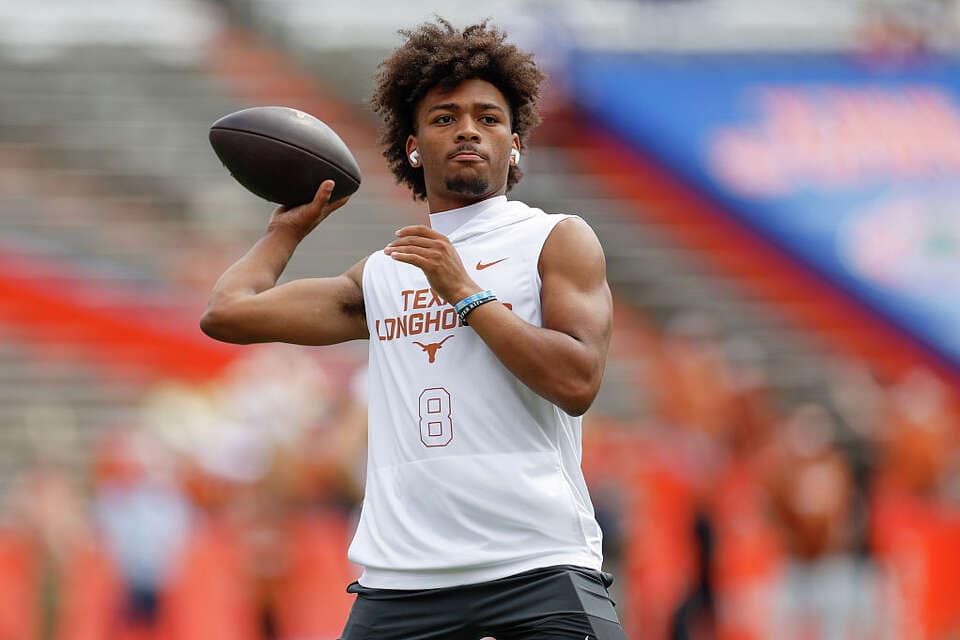
The Challenge Of Growing Behind A Star
There is a specific difficulty to developing behind a quarterback who dominates the narrative. A player in Lacey’s position must prove he is improving without the volume of visible moments that normally drive public confidence. He has to show command without the game-day runway. He has to separate himself in practice, in meeting rooms, and in the small evaluative windows that coaches treat as decisive.
For that reason, the word “separate” is the right one.
Not every backup battle is about direct competition for the starting job. Often it is about clarity. Coaches want to know who can run the offense cleanly if needed. They want to know who processes quickly, who protects the ball, who keeps timing intact, and who earns the trust of veteran skill players. Separation, in this context, is not theatrical. It is operational.
The Texas quarterback room is not short on bodies. The official 2026 roster lists Manning, Lacey, Dia Bell, MJ Morris, and Luke Dunham, which gives the staff a range of experience levels and developmental profiles to sort through.
What makes Lacey especially interesting is that he sits at the point where promise is supposed to start becoming shape. He is no longer simply the name fans file away for later. He is at the stage where a contender expects a quarterback to begin looking like a legitimate answer to a real football question.
Why KJ Lacey Has Become The Name To Watch
When I look at this situation, I see a player with a narrow but important lane. Lacey does not need to win the offseason news cycle. He needs to emerge as the quarterback who clearly belongs in the next sentence whenever Texas discusses the future of the position.
That matters because quarterback depth charts are not built only on upside. They are built on credibility. Coaches can manage a room with multiple talented players if one backup clearly owns the trust of the staff. What gets harder is carrying ambiguity into the season. Ambiguity invites pressure, second-guessing, and constant re-litigation of every rep.
If Lacey can remove that ambiguity, even partially, he changes the tenor of the room.
The appeal of this storyline is also structural. Texas is operating at a level where the quarterback room has to serve two timelines at once. One timeline is immediate: support Manning, protect the season, and make sure the offense can function under stress. The other is strategic: identify who can become the next meaningful option without forcing a rushed decision later.
Programs lose momentum when they neglect the second timeline. They become starter-dependent and succession-poor. That is the danger Texas wants to avoid.
The Standard At Texas Is Different Now
This is not a rebuilding conversation. It is a contender conversation.
That distinction matters because the standard for a Texas backup quarterback is not simply competence. It is readiness in a high-pressure ecosystem. The Longhorns are no longer being judged on whether they can collect talent. They are being judged on whether they can sustain championship infrastructure, and quarterback depth is one of the clearest tests of that infrastructure.
I think that is why this discussion feels more urgent now than it might at another moment in the program’s arc. In a less mature program, a backup quarterback can remain a future-facing project. In a playoff-caliber program, that same player becomes part of the current operating model. He is not only a developmental investment. He is a live variable in the season.
Lacey is therefore being measured against something bigger than his own résumé. He is being measured against Texas’s need for certainty.
That is a tough standard, but it is also the standard that reveals whether a quarterback is truly moving.
What Separation Would Actually Look Like
Fans often treat quarterback separation as a dramatic event, but in my experience it usually shows up in subtler ways first. The offense feels cleaner when one player is in. The ball comes out on time. Concepts are communicated crisply. Teammates respond with less hesitation. Coaches speak with more confidence, even when they are trying not to say much.
If Lacey is going to distinguish himself, it will likely begin there.
It could show up in command of situational football. It could show up in how decisively he handles the middle of the field. It could show up in how often the offense stays on script when he is directing it. A backup quarterback does not have to be spectacular to be valuable. He has to be reliable in ways that travel.
That is why the conversation around him deserves more seriousness than backup-quarterback discourse usually gets. At Texas, this is not just about curiosity over a name lower on the depth chart. It is about whether the Longhorns can identify a clear No. 2 with enough upside to matter beyond emergency duty.
The Bigger Issue Is Long-Term Stability
This is where the subject becomes more consequential than one season.
If Lacey takes a visible step, Texas gains more than reassurance behind Manning. It gains continuity. It gains a clearer development ladder. It gains leverage against the volatility that now defines roster management across the sport. Quarterback stability has become one of the hardest things to maintain in modern college football, which is precisely why smart programs invest in it early and obsess over it constantly.
That is also why the KJ Lacey Texas football conversation is worth following closely. It is not just about one player’s push for relevance. It is about how Texas protects itself against the fragility that comes with building around a star.
If Lacey becomes the clear backup, the room looks healthier. If he looks like more than that, the room starts to look durable.
Those are different outcomes, and both would matter.
Why This Matters Right Now
Texas does not need a quarterback controversy. It needs quarterback clarity. Manning remains the centerpiece, but every serious contender eventually reaches a moment when the strength of its second option becomes part of the season’s credibility.
That is why this storyline matters now, not later. If KJ Lacey can separate himself this season, Texas gains more than a backup. It gains structure, confidence, and a more believable future at the most important position in the sport. In a program trying to win at the highest level, that is never a minor development.