
Texas enters the 2026 season with expectations that extend beyond conference contention. The program is positioned in a national championship conversation that now centers on Arch Manning, the former five-star quarterback whose development into a full-time starter has become the defining variable for the Longhorns’ trajectory.
Manning’s performance in 2025 set a foundation that raised expectations across college football. He finished the season with more than 3,100 passing yards, 26 passing touchdowns, and 10 rushing touchdowns, showing command of Steve Sarkisian’s offense in high-pressure moments. That production placed Texas firmly within the national title discussion heading into 2026.
The upcoming season shifts the context. It is no longer about potential or development phases. It becomes a direct evaluation of whether Texas can convert elite quarterback play into championship execution within the SEC.
Arch Manning’s Role Now Extends Beyond Development
Manning’s first full season as the unquestioned leader of the Texas offense carries implications that extend beyond box scores.

His 2025 campaign showed consistency in intermediate passing concepts and improved command of pre-snap reads, especially against SEC-level defenses. Those elements created stability in an offense that already ranked among the most efficient in college football.
The 2026 season raises the difficulty level. Texas will face defensive fronts built with depth, speed, and rotational pressure packages that reflect SEC standards. Quarterbacks in that environment are evaluated not just on production, but on response under sustained defensive stress.
National analysts continue to project Manning among the top quarterbacks in the country heading into the season, with early 2027 NFL Draft conversations already shaping his profile according to ongoing coverage from ESPN college football analysis.
Texas’ offensive structure under Sarkisian is designed to support quarterback decision-making through layered route concepts and balanced run-pass sequencing. Manning’s ability to operate within that structure will determine how far the Longhorns can advance in the postseason picture.
Texas Offense Enters A Stability Phase With High Expectations
Texas returns a system that has matured into one of the more consistent offensive units in the country.
The combination of Manning’s development, Sarkisian’s play design, and a supporting cast built through recruiting and transfers has created a balanced attack capable of sustaining drives against elite defenses.
The margin for error narrows in 2026.
SEC defenses routinely force offenses into long-yardage situations, where quarterback efficiency becomes the deciding factor. Manning’s decision-making in those scenarios will carry increased weight.
Recent recruiting momentum around Texas’ roster construction reflects this expectation. The program has prioritized offensive line depth and skill position balance to support quarterback stability in high-leverage games.
Texas’ broader roster-building strategy, including defensive line investments discussed in our coverage of Texas recruiting momentum trends, reflects an understanding that championship windows require complementary development on both sides of the ball.
Offensive efficiency alone does not define SEC success.
Sustained defensive performance and situational execution complete the picture.
SEC Competition Sets A Higher Benchmark For Quarterback Play
The SEC environment introduces a different evaluation standard for quarterbacks.
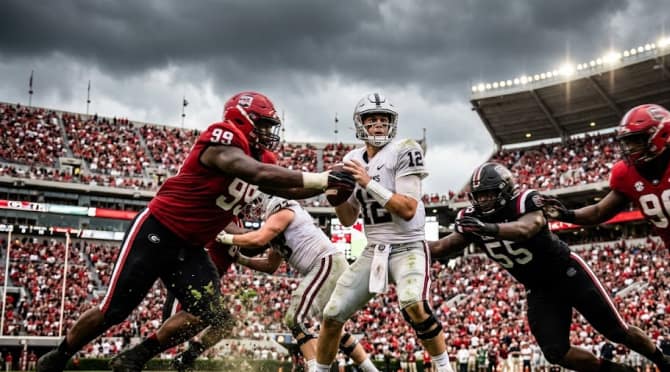
Unlike non-conference schedules that may feature varied defensive systems, SEC matchups consistently present speed, complexity, and depth across defensive units.
Manning will face defenses that adjust quickly, disguise coverage looks, and generate pressure without relying on blitz-heavy schemes. That structural consistency forces quarterbacks to process information faster and operate within tighter windows.
Texas’ move into the SEC has already changed recruiting expectations. It has also reshaped how quarterback performance is evaluated nationally.
Programs competing for championships in the conference typically require quarterbacks who can sustain efficiency across full seasons without statistical volatility.
Manning’s 2026 season will serve as a direct comparison point with other top SEC quarterbacks, many of whom are entering similar developmental stages within their programs.
External recruiting and performance tracking platforms such as 247Sports player evaluations continue to rank quarterback performance using efficiency metrics, turnover avoidance, and performance against ranked opponents.
Those benchmarks will define how Manning’s season is assessed in real time.
Supporting Cast Development Will Influence Championship Trajectory
Quarterback performance rarely exists in isolation.
Texas’ ability to compete for a national title in 2026 will depend heavily on supporting roster development, particularly along the offensive line and skill positions.
Protection schemes will dictate how much time Manning has to operate within the pocket. Receiver separation will determine whether intermediate throws convert into explosive gains.
Texas has worked to stabilize both areas through recruiting cycles and portal additions, aiming to reduce volatility in offensive execution.
That structure matters in high-pressure SEC environments.
Offensive consistency often determines postseason outcomes more than peak performance alone. Programs that maintain efficiency across multiple phases of offense tend to advance deeper into playoff competition.
Manning’s leadership role extends into that structure. His command of pre-snap adjustments and in-game communication will influence how effectively Texas sustains drives against elite defenses.
National Title Window Now Tied Directly To Quarterback Execution
Texas enters 2026 with one of the clearest championship trajectories in college football.
The roster construction, recruiting foundation, and conference positioning have aligned the program within national title discussions. The remaining variable centers on quarterback execution under SEC conditions.

Manning represents that variable.
His development trajectory has already validated Texas’ long-term recruiting strategy at the position. The next phase involves converting that development into consistent performance against top-tier competition.
Programs that win national championships typically do so with quarterbacks capable of maintaining composure across high-pressure stretches of the season.
Texas is positioned within that framework.
The 2026 season will test whether that position translates into sustained results or remains a projection of potential.