Friday Night Lights Texas football identity still hits because the show never treated football as just a game. It understood something outsiders often miss: in Texas, football is a public language, a family argument, a civic ritual, and sometimes the easiest way for a town to explain itself.
That is why the show’s 20-year anniversary moment in Austin feels larger than television nostalgia. It lands at a time when Texas football is again measuring itself against impossible expectations, and that same pressure is already shaping the way fans talk about a season where good may not be good enough.
Friday Night Lights Texas Football Identity Was Never Just About Dillon
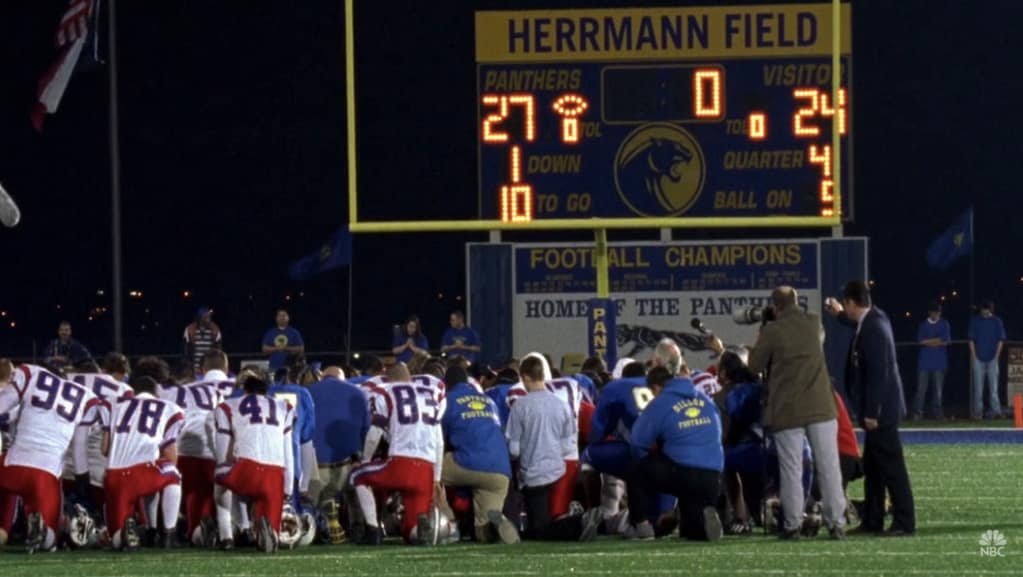
The fictional town of Dillon worked because it felt specific without being narrow. It had a coach, a field house, a booster culture, a quarterback problem, and families carrying more than the scoreboard could show.
That is why the series still resonates with Longhorn fans, high school fans, and anyone who has sat under Texas lights on a Friday night. It captured the emotional machinery behind the sport.
The point was never that every Texas town looks exactly like Dillon. The point was that football in Texas often gives people a shared stage. Players become symbols. Coaches become public figures. Parents become scouts, critics, defenders, and historians. A single game can feel like a referendum on discipline, pride, and belonging.
That is Texas football memory at work. It is not just remembering who won. It is remembering where you sat, who you were with, what the season felt like, and why the moment seemed bigger than the ball.
Mack Brown’s 2005 Shadow Made The Show Feel Bigger
The timing mattered. Friday Night Lights arrived on television after Mack Brown’s Texas program had just reached the summit of college football, with the Longhorns’ 2005 national championship turning Austin into the center of the sport’s imagination.
That backdrop gave the show a sharper Texas credibility. The state was not merely football-obsessed in theory. It had the national trophy, the star quarterback, the coach, the swagger, and the proof.
The official memory of Texas’ 2005 title still lives through the Longhorns’ own celebration of the 2005 National Champions, but the cultural echo moved beyond the Rose Bowl. It fed into a broader idea that Texas football was not just successful. It was cinematic.
That matters because Friday Night Lights did not have to manufacture importance. Texas had already done that. The show simply slowed the camera down and asked what that importance does to people.
It showed that pressure can inspire a community, but it can also squeeze teenagers, marriages, coaches, and towns. That was the honest part. Texas football pride is real. So is the cost of turning young players into local mythology.
Austin Turned The Anniversary Into A Homecoming
The recent anniversary spotlight in Austin makes sense because Friday Night Lights was never emotionally separate from Central Texas. The show’s return through the ATX TV Festival gave the moment the feel of a homecoming rather than a distant Hollywood reunion.
That distinction matters. A reunion in Los Angeles would have been entertainment history. A reunion in Austin becomes local memory.
The cast and creative team returning to the place tied to the show’s production reinforces why the series still belongs in Texas football conversation. It did not just borrow the state as scenery. It used Texas as texture: the heat, the fields, the booster tension, the family rooms, the uneasy silence after a loss.
Here is the simple reason the anniversary still works for football readers:
| Texas Football Layer | What Friday Night Lights Captured | Why It Still Matters |
|---|---|---|
| Community pride | Football as a shared local identity | Fans still treat seasons as civic mood swings |
| Coaching pressure | The coach as leader, counselor, and target | Expectations now follow every major program year-round |
| Player visibility | Teenagers becoming public symbols | Recruiting and social media have only intensified that spotlight |
| Family stakes | Football affecting homes, marriages, and futures | The sport still carries emotional weight beyond the field |
| Texas mythology | Lights, fields, rituals, and reputation | Tradition remains part of the state’s football appeal |
The table explains why the show has aged better than many sports dramas. It was not built only on plot twists. It was built on pressures that still exist.
The Show Understood The Stands As Much As The Field
Many football stories fail because they think the game is only happening between the sidelines. Friday Night Lights understood that the stands are part of the story.
The people watching are not passive. They bring expectations, grudges, hopes, and memories. They treat third down like a public mood test. They second-guess play calls because they are also second-guessing what kind of town, school, or program they believe they belong to.
That is why the show remains useful for understanding Texas football fandom today. Whether the subject is high school tradition or Longhorn expectations, the same emotional structure appears. The crowd wants victory, but it also wants confirmation.
Confirmation of toughness. Confirmation of identity. Confirmation that the program still understands what the logo, town, or school is supposed to mean.
That is a cultural scoreboard, and it is often less forgiving than the real one.
Texas Football Still Lives On Ritual As Much As Results
The modern sport is faster, richer, and more nationally packaged than it was when Friday Night Lights first aired. Recruiting is more public. Player movement is more visible. College football schedules feel engineered for television windows and playoff arguments.
Yet the core Texas football experience still depends on ritual.
The drive to the stadium. The pregame heat. The family text thread. The old stories about better teams, tougher defenses, and louder nights. The nervous confidence before kickoff. The immediate overreaction after the first stalled drive.
That is stadium logic. It does not always make sense on paper, but it explains how fans process the sport emotionally.
Friday Night Lights remains powerful because it respected those rituals instead of mocking them. It knew football could be excessive and beautiful at the same time. It could unite people and expose their worst instincts. It could create opportunity and pressure in the same breath.
Texas fans understand that contradiction without needing it explained. They live it every season.
The Next Test Is Whether The Myth Still Fits The Modern Game
The danger for any football culture is turning memory into a costume. Tradition can inspire a program, but it can also trap one. The deeper question for Texas football is whether the emotional power captured by Friday Night Lights still fits a sport now shaped by money, media, transfers, playoff math, and national branding.
That is the pressure point worth watching.
If Texas football only sells nostalgia, the story gets stale. If it uses tradition as a standard for accountability, connection, and atmosphere, the old magic still has teeth.
The same is true for Friday Night Lights itself. Its legacy should not be reduced to slogans or reunion applause. Its real value is that it gave Texas football fans a mirror. Not always a flattering one, but a recognizable one.
The show reminded people that football feels different here because the sport carries more than entertainment. It carries memory, identity, expectation, and belonging.
That is why Friday Night Lights Texas football identity still matters in 2026. The lights are not just bright because the games are big. They are bright because Texas keeps asking football to explain who it is, who it was, and what it still expects to become.